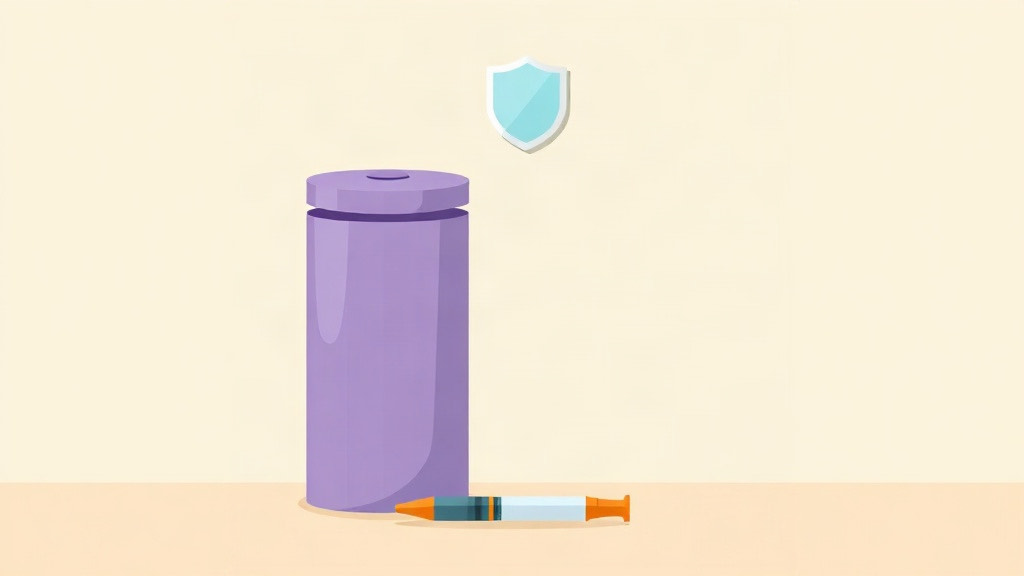
Every GLP-1 injection produces one small piece of medical waste, and the question of what to do with it usually arrives about ten seconds after the first shot, with the used needle still in your hand and no obvious place to put it.
The good news is that the safety part is simple and the same everywhere. The disposal part is simple too, but it is genuinely local: what a neighboring county accepts may not be what yours does. Here is the whole picture, in the order you will need it.
What actually counts as a sharp
A sharp is anything that can pierce skin. For GLP-1 users that usually means one of two things.
- The used pen needle. If your pen takes a separate screw-on needle, that needle is the sharp. It comes off after the injection and goes straight into the container, while the pen itself stays in use until it is empty.
- The whole pen. Some single-use disposable pens have a needle that is built in and cannot be removed. In that case the entire pen is handled as a sharp when it is done.
Syringes and lancets belong in the same container. If you cannot tell from the packaging which kind of device you have, the pharmacy that filled the prescription can answer that in a sentence, and it is worth asking on the first fill rather than improvising later.
Three things that are never acceptable
FDA guidance is direct about this, and it is the part of the topic that does not vary by zip code:
- Never put loose sharps in household or public trash bins.
- Never put loose sharps in recycling bins.
- Never flush sharps down the toilet.
The reason is not squeamishness. A needle loose in a trash bag is a needle that someone else eventually handles: a family member pressing down the garbage, a sanitation worker lifting the bag, a curious pet nosing through it. Sorting facilities move recycling by hand more often than people assume. The FDA's recommendation is to place used needles and other sharps in a sharps disposal container immediately after use, specifically to reduce the risk of needle-sticks, cuts and punctures.
Immediately is the operative word. A needle set down "just for a second" on a bathroom counter is the one that ends up somewhere it should not be. If you already keep a small routine around your shot, described in our weekly shot tracking guide, adding the container to that routine costs nothing.
The container: what to get and where to get it
The recommended option is an FDA-cleared sharps disposal container. These are made of puncture-resistant plastic with leak-resistant sides and bottom and a tight-fitting, puncture-resistant lid, and they are generally available through pharmacies, medical supply companies, health care providers and online retailers. Some prescribers will supply one or write for one, so it is worth asking at the visit where the prescription starts.
When a cleared container is not available, some organizations and community guidelines suggest a heavy-duty plastic household container with a screw-on lid as an alternative, a laundry detergent bottle being the example that comes up most often. It is worth being precise about what that is: a widely suggested stopgap, not an FDA-endorsed equivalent. Some drop-off programs will only accept a cleared container, and a repurposed bottle that arrives at the wrong site becomes your problem again. If you use one, label it clearly and confirm in advance that your local program will take it.
 GLP 1 Tracker AppFree on the App Store. Log every shot with a date stamp, so supplies, refills and containers never surprise you.
Get the app
GLP 1 Tracker AppFree on the App Store. Log every shot with a date stamp, so supplies, refills and containers never surprise you.
Get the app
Where the container lives, and how full it gets
Placement is half the safety story. Three habits cover it:
- Keep it upright on a stable surface, so nothing can spill out if it is bumped.
- Keep it out of reach of children and pets. A container that is easy for you to reach and impossible for a toddler to reach is the target, which usually rules out a low shelf or the floor beside a trash can.
- Keep it where you inject. If your shot happens at the kitchen table and the container lives in a hall closet, the needle travels, and traveling needles are the ones that get set down.
On fill level, the guidance is to dispose of the container when it is about three-quarters full, following your community guidelines. Do not top it off. An overfilled container is hard to close properly, and the moment of forcing a lid onto a full container is exactly when a stick happens. If you also rotate injection spots, and you should, our guide to injection site rotation pairs naturally with a fixed shot-day station: same place, same order, container included.
Getting rid of a full container
This is where the national answer runs out. Disposal guidelines and programs vary by state and locality, and enforcement falls to states and sometimes to individual counties or cities. That is not a hedge; it is the actual structure of the rules, and it is why any confident-sounding universal instruction you read online should be treated with suspicion.
Options that exist in many places include:
- Drop-off sites: hospitals, physician offices, pharmacies, fire stations, police stations and community health clinics.
- Household hazardous waste: some areas accept sharps at permanent collection sites or at periodic collection events.
- Mail-back programs: a container is mailed back for disposal for a fee that varies with container size.
Notice that the same list can be right in one place and wrong a few miles away. A pharmacy chain that takes containers back in one state may not in another, a fire station that accepts them in one town may have no such program in the next, and a household hazardous waste site may run collection events only twice a year. That is why a confident national rule of thumb, including any you find on a forum, is worth exactly nothing until you have matched it against your own program.
The step that matters is checking which of those applies to you before your container is full. Your city or county solid waste or household hazardous waste department is usually the fastest source, your state health or environment department publishes the rules behind it, and the pharmacy that fills your prescription often knows what people in the area actually do. One phone call or one search on your county's own site settles it for years.
It is also worth asking before you travel. Hotels, airports and other people's homes have their own arrangements, and our travel guide covers keeping medication and its accessories organized on the road.
Knowing when the next container is due
A sharps container fills at an entirely predictable rate, which makes running out of room a solvable problem rather than a surprise. One weekly injection is roughly four or five needles a month. A daily medication is a different arithmetic entirely, and a household with two people injecting is different again.
This is the small place where a dose log earns its keep. When every shot is stamped with a date, you can see at a glance how many injections a month you actually take, which tells you roughly how long a container of a given size lasts and when to order or pick up the next one. The same log is what makes the refill conversation concrete, alongside the supply check described in our guide to storing pens at home.
None of this needs to be elaborate. A cleared container within arm's reach of where you inject, a lid closed at three-quarters full, and one known answer for where it goes in your county. That is the entire system, and once it is set up it never needs thinking about again.
Try it freeNo account, no ads. Shot-day reminders and a date-stamped log of every injection.
Download
Frequently asked questions
Can I throw used GLP-1 needles in the household trash?
No. FDA guidance is consistent on this point: loose sharps should never go into household or public trash or recycling bins, and they should never be flushed down the toilet. A loose needle can injure sanitation workers, family members or pets long after you have forgotten about it. Place used needles in a sharps disposal container immediately after the injection, then dispose of the full container through a program your city, county or state accepts.
What can I use if I do not have an FDA-cleared sharps container?
FDA-cleared containers are made of puncture-resistant plastic with leak-resistant sides and bottom and a tight-fitting, puncture-resistant lid, and they are generally available through pharmacies, medical supply companies, health care providers and online. When one is not available, some organizations and community guidelines suggest a heavy-duty plastic household container with a screw-on lid, such as a laundry detergent bottle. Treat that as a fallback rather than an FDA-endorsed equivalent, and check whether your local drop-off site accepts it.
Do I throw away the whole pen or just the needle?
It depends on the device. If your pen takes a separate screw-on needle, the needle is the sharp and goes into the container after every injection, while the pen itself keeps being used until it is empty or its in-use window ends. If the needle is fixed to a single-use disposable pen and cannot be removed, the whole pen is handled as a sharp. If you are not sure which kind you have, the pharmacy that filled the prescription can tell you in one sentence.
Where do I take a full sharps container?
It depends entirely on where you live, because disposal rules are set by states and sometimes by individual counties or cities. Options that exist in many places include hospitals, physician offices, pharmacies, fire stations, police stations and community health clinics. Some areas accept sharps at household hazardous waste collection sites or events, and mail-back programs exist for a fee that varies with container size. Check your own city, county and state program before you drive anywhere.
How full should a sharps container get before I close it?
About three-quarters full, then close it and follow your community guidelines for disposal. Overfilling makes the lid hard to seat safely and raises the chance of a needle-stick when the container is handled or transported. Keep the container upright and out of reach of children and pets while it is in use, and line up the next one before the current one is nearly done.