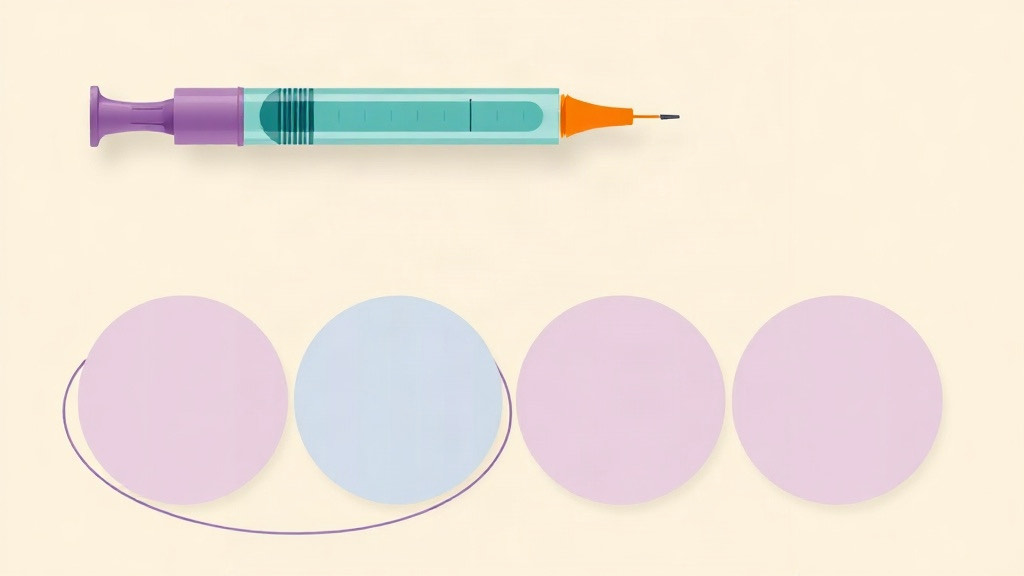
Once a week sounds like the easiest schedule in medicine. It is actually one of the trickiest. Daily habits attach themselves to daily life: teeth get brushed, coffee gets made, pills sit in a Monday-through-Sunday organizer. A weekly event has no such scaffolding. It floats, anchored to nothing but the memory of the last one, and memories of "last Thursday, probably" are exactly as reliable as they sound.
So a weekly GLP-1 injection deserves a real tracking system, not because the medication is complicated but because the schedule is unforgiving of fuzz. Here is what to record, why casual systems fail, and the small ritual that makes the whole thing effortless.
The five things worth recording at every shot
A useful shot log is five fields, and only one of them needs a keyboard:
- The time. Not the day: the moment. Every official late-dose rule is measured in days and hours from the last injection, so "Thursday evening" is a weaker record than a timestamp. Logging at the moment of injection makes this automatic.
- The dose. During titration your dose changes every few weeks, and months later you will want to know exactly when. One tap on your current ladder step beats typing numbers.
- The site. Abdomen, thigh or upper arm, and roughly where. Site rotation only works if somebody remembers last week’s spot, and that somebody should not be you. Our rotation guide explains what skipping this quietly costs.
- How you felt. A severity rating for anything notable in the day or two after the shot: nausea, fatigue, injection site reactions. Effects on weekly GLP-1s tend to cluster after dose day, and that pattern only becomes visible in a log.
- The week of your step. "Week 3 of 4 at 0.5 mg" is the coordinate your prescriber navigates by. A tracker with real ladders counts this for you; on paper, it is the first number people lose.
Recorded together, these five fields answer essentially every question a prescriber, a pharmacist or a worried Sunday-night version of you will ever ask about your injections.
Why paper and notes apps decay by week six
Most people do not start with an app. They start with a kitchen calendar, a notes file, or the confidence of someone who has never yet missed a dose. These systems share a failure pattern: they work brilliantly for a month, then decay. The calendar goes unmarked during one busy weekend and the streak of checkmarks loses its authority. The notes file demands typing at exactly the moment your hands are busy with a pen and an alcohol swab, so one week gets logged from memory the next morning, then two, and the timestamps quietly turn into fiction.
The deeper problem is that passive records cannot do math or speak up. A calendar cannot notice that shot day has come and gone. A note cannot tell you that it has been 4 days and 6 hours since the last dose, which happens to be the exact kind of arithmetic the official missed-dose windows demand: 5 days for Ozempic, 4 for Mounjaro and Zepbound, a 48-hour rule for Wegovy. When a dose actually goes missing, a passive log leaves you reconstructing the timeline; an active one already knows it. The stakes of that difference are the whole subject of our missed dose guide.
None of this is a character flaw. It is what happens when a weekly task meets a system with no reminders, no structure and no clock. The fix is to move the remembering out of your head entirely.
 GLP 1 Tracker AppFree on the App Store. One-tap dose logging, shot-day reminders, overdue alerts, and every entry stamped to the minute.
Get the app
GLP 1 Tracker AppFree on the App Store. One-tap dose logging, shot-day reminders, overdue alerts, and every entry stamped to the minute.
Get the app
Reminders that survive real life
A good reminder system for a weekly injection has two layers. The first is the shot-day reminder: a notification at a time you actually choose, on the day the schedule says. The second layer matters more: an overdue alert that fires when the reminder came and went without a logged dose. First notifications get swiped away in checkout lines and school pickups; the follow-up is what separates a tracker from an alarm clock. Both should be local notifications from the app on your phone, not messages from someone’s server, which is also why they work in airplane mode and why no company needs to know your schedule to deliver them.
Choose the reminder moment with the same care as the shot day itself: a time you are reliably home, unhurried, and near the refrigerator where the pen lives. For many people that is a weekend morning. If your shot day itself needs to move, the labels allow it within minimum-gap rules, and a logged history makes the transition clean rather than guessed. If the refrigerator itself is the uncertain part, our guide to storing GLP-1 pens in the fridge covers where they belong and for how long.
The two-minute weekly ritual
Consistency comes from sequence, not willpower. A shot-day ritual worth copying: reminder fires, pen comes out of the fridge, the app’s log shows last week’s site so this week’s rotates one position on, inject, and log before the pen cap is back on: dose, site, done. Two minutes including the swab. The log entry is part of the injection, not a separate task to remember later, and that fusion is the entire secret. Then, in the day or two after, a ten-second severity note if anything is worth noting.
If you enjoy a fuller picture, shot day is also a natural moment for the weekly extras: a weight entry if you are not a daily weigher, a glance at the water and protein trend, a look at how the past step treated you. Our guide to a two-minute daily routine covers the between-shots days for people who want them; none of it is required for the shot log itself to do its job.
What the log becomes over months
Week to week, a shot log feels almost trivial: a row of taps. Its value compounds. Three months in, it is the answer sheet at your follow-up: every dose dated, every step’s week count exact, side effects mapped against increases. Six months in, it is the context behind an educational medication-level curve, showing how your logged doses stack into a steady state and what a late one actually looked like. A year in, it is the honest history of the whole undertaking: the holds, the schedule moves, the travel weeks, all remembered precisely when memory alone would have smoothed them into "pretty consistent, mostly."
That is the quiet case for tracking well: not that any single entry matters much, but that the accumulated record turns every future question, from a pharmacist’s to your own, into a lookup instead of a reconstruction. And when your care team wants the record itself rather than a summary, an export turns a year of taps into a file a clinic portal or dietitian can actually take. If you are choosing the tool to do all this with, our tracker checklist covers what separates a purpose-built GLP-1 tracker from a generic reminder app, privacy included.
The takeaway
Track five things at every shot: time, dose, site, feeling, and week of step. Let reminders and overdue alerts own the remembering, log at the moment of injection so the timestamps stay true, and fold it all into one two-minute ritual. A weekly injection will never anchor itself to daily life; a small system anchors it instead, and the record it builds pays for those two minutes many times over.
Frequently asked questions
What should I record every time I take my GLP-1 shot?
Five things: the time (a real timestamp, not just the day), the dose, the injection site, how you felt in the day or two after (rated for severity), and which week of your titration step you are on. Logged at the moment of injection, the whole set takes under a minute, and together the five fields answer nearly every question a prescriber or pharmacist will ask.
Why does the exact time of my GLP-1 injection matter, not just the day?
Because the official late-dose rules are measured in days and hours from the last injection. Per the labels, Ozempic allows a late dose within 5 days, Mounjaro and Zepbound within 4 days, and Wegovy’s rule depends on whether the next dose is more than 2 days away. When a dose slips, a timestamped log answers instantly whether you are inside a window; a vague memory of the day does not.
Is it better to track GLP-1 shots on paper or in an app?
Paper calendars and notes apps tend to work for about a month, then decay: entries get reconstructed from memory, timestamps drift, and a calendar cannot notice that shot day passed unlogged. An app adds the two things passive records lack, reminders and arithmetic: an overdue alert when no dose was logged, and an exact count of days and hours since the last injection when a dose slips.
How do I remember to take my weekly GLP-1 injection?
Use two layers. First, a shot-day reminder at a moment you are reliably home, unhurried and near the refrigerator, which for many people is a weekend morning. Second, an overdue alert that fires if the reminder came and went without a logged dose. First notifications get swiped away in busy moments; the follow-up alert is what actually protects the schedule.
Is there a free app to track GLP-1 injections?
Yes. GLP 1 Tracker App is free on the App Store for iPhone: one-tap dose logging on real titration ladders, shot-day reminders, overdue alerts, injection site notes and a side effect diary, with no account, no ads and no data collection. An optional Premium subscription adds unlimited history, 90-day side effect trend charts, a home screen widget and CSV or JSON export.