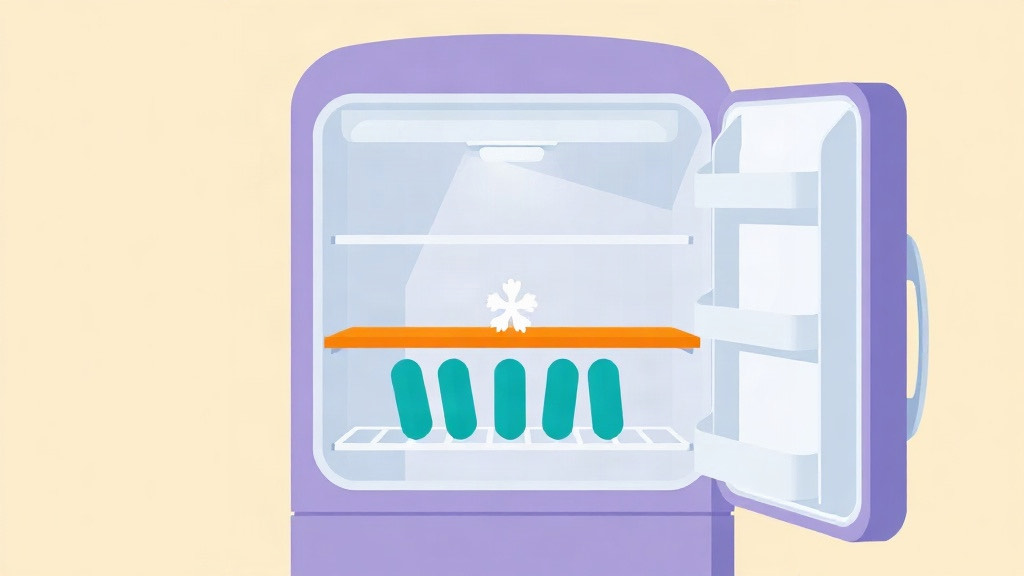
A GLP-1 prescription quietly turns your refrigerator into medical storage. Most people set the box on whatever shelf has room, and most of the time that works fine. The times it does not are expensive: a pen wedged against the back wall that froze, a pen lost behind the leftovers until it expired, a refill request placed on the morning it was already needed.
This is the home system, not the travel one. If you are packing for a trip, our travel guide covers coolers, temperature windows on the road and time zones. What follows is the boring version that runs the other fifty weeks of the year.
Which shelf, and the two places to avoid
Commonly published label guidance is that unopened pens are refrigerated at 2 to 8 C (36 to 46 F). A home refrigerator does not hold one temperature throughout, which is the whole reason placement matters.
The practical target is a middle or lower shelf, toward the middle of that shelf. Two spots are worth actively avoiding:
- The door. It is the most convenient spot and the worst one. Every time the fridge opens, the door shelf swings out into room air, and a door bin cycles through more temperature swings in a week than the rest of the compartment sees in a month.
- The back wall and anything under a freezer vent. This is the coldest zone in the compartment, and it is where accidental freezing actually happens. Items pushed to the very back can freeze even when the fridge is set correctly.
A fridge thermometer costs almost nothing and removes the guessing entirely, which is worth it if your appliance is old, if it is a dorm-sized unit, or if you have ever found ice on something that should not have any.
Freezing is the one mistake you cannot undo
Nearly everything else in GLP-1 life has a recovery path. A late dose has a published window. A rough week of side effects usually settles. Freezing does not work that way: the labels are consistent that these medications must never be frozen, and that a pen which has been frozen should not be used, even if it thaws and looks perfectly normal.
That is why the back wall matters more than it sounds. It is also why, if you suspect a pen got too cold, the answer is not to inspect it and decide for yourself. Set it aside and ask your pharmacist. We say more about how to think through that kind of moment in left your pen out overnight, which covers the other temperature direction.
Keep the carton
Pens are easier to store loose, and that is exactly the temptation to resist. Keeping each pen in its original carton until you start using it does two jobs at once.
First, the carton shields the medication from light. Second, and more practically, it keeps the identifying information physically attached to the medication: your name, the product and strength, the lot number and the expiration date. When you call a pharmacist with a storage question, the first thing they will ask is exactly what you have, and reading it off the box beats describing the color of a pen over the phone.
Cartons also stack and label better than bare pens. Writing the fill date on the end flap with a marker turns a shelf of identical boxes into a queue.
 GLP 1 Tracker AppFree on the App Store. Every dose stamped with a date, so you always know which pen is in use and how many are left.
Get the app
GLP 1 Tracker AppFree on the App Store. Every dose stamped with a date, so you always know which pen is in use and how many are left.
Get the app
Rotate front to back, and know which pen is in use
Grocery stores solved this problem decades ago and the method transfers exactly: new stock goes behind, old stock stays in front, and you always take from the front. A new fill goes to the back of the row; the pen you reach for is the one that has been waiting longest.
The second half of the system is knowing which pen is the one currently in use and when it came out of the fridge. That is the fact people lose. A pen in a drawer, a pen in a bag and a pen on the counter all look identical to a pen that has never been opened, and a week later nobody can say which was which.
Two habits fix it permanently:
- Give the in-use pen its own spot, and only that spot. Everything else stays in a carton in the row.
- Record the date the current pen came out of the fridge. Written on the carton, in a note, or in your dose log, but recorded somewhere that is not memory.
The room-temperature clock does not reset
This is the single most misunderstood storage fact, and it is worth stating plainly: the room-temperature allowance is cumulative time out of the refrigerator, not a clock that restarts each time the pen goes back in.
Three hours on the counter on Sunday, an afternoon in a bag on Wednesday and a forgotten evening the following week all add to the same total. Putting the pen back in the cold does not buy back the time already spent out. Where the clock starts differs by product, which is the detail most easily missed: an Ozempic pen stays refrigerated until first use and then has its window, while the single-dose pens count total time out of the refrigerator. Tirzepatide goes further still and tells you not to put the pen back in the fridge at all once it has been at room temperature, so read your own carton rather than borrowing a rule from a friend on a different medication.
These are the commonly published label figures. Check your own product's label, which comes with every fill, and confirm anything uncertain with your pharmacist:
| Medication | In the refrigerator | Commonly published room-temperature allowance |
|---|---|---|
| Ozempic (semaglutide, multi-dose pen) | 2 to 8 C (36 to 46 F) until first use, never frozen | Up to 56 days at or below 30 C (86 F), counted from first use |
| Wegovy (semaglutide, single-dose pen) | 2 to 8 C (36 to 46 F), never frozen | Up to 28 days total out of the refrigerator, at or below 30 C (86 F) |
| Mounjaro / Zepbound (tirzepatide, single-dose pen) | 2 to 8 C (36 to 46 F), never frozen | Up to 21 days total out of the refrigerator, at or below 30 C (86 F). The label also says not to return the pen to the refrigerator once it has been stored at room temperature |
| Rybelsus (oral semaglutide) | Not refrigerated. Stored at room temperature in its original bottle with the cap closed to keep moisture out. | |
Rybelsus really is the odd one out here, and it is easy to over-apply fridge rules to it out of habit. It is a tablet, it lives at room temperature, and its demands are about timing rather than temperature, as our Rybelsus guide explains. Never freeze any of the injectables, and never assume one product's window applies to another.
The shot-day supply check
The last habit is the one that prevents the genuinely stressful version of this topic, which is not a warm pen but an empty shelf.
Shot day already interrupts your week, so attach the check to it. When you log the injection, look at the row: how many cartons are behind the one you just used, and does that cover you until the next fill can realistically arrive? Pharmacy timing, prior authorization and supply availability all take days rather than minutes, and a request placed with two pens in reserve is a routine errand, while the same request placed with zero is an emergency.
A dose log makes that arithmetic exact instead of approximate. Every injection is stamped with a date, so you can see when the current pen started being used, how many doses it has left, and how many weeks of supply are sitting behind it. That turns "I think I have a couple left" into a number, and it is the same record that keeps refills, daily logging and appointment conversations grounded in fact rather than recollection.
None of this is complicated. One shelf, never the door and never the back wall, cartons kept, oldest in front, the in-use pen with a known start date, and a supply glance every shot day. Set it up once and your refrigerator stops being a source of surprises.
Frequently asked questions
Where in the fridge should I keep my GLP-1 pens?
A middle or lower shelf, toward the middle of that shelf, is the usual sweet spot. The door swings through a temperature change every time the fridge is opened, and the back wall or the area under a freezer vent is the coldest part of the compartment, which is where accidental freezing happens. Commonly published label guidance for unopened pens is 2 to 8 C (36 to 46 F). Check your own product's label.
Can I use a GLP-1 pen that froze?
Product labels are consistent that these medications must never be frozen and that a pen which has been frozen should not be used, even if it thaws and looks completely normal. Freezing is the one storage mistake with no recovery. If you think a pen may have frozen, set it aside and ask your pharmacist rather than injecting it or discarding it on a guess. Check your own product's label as well.
Should I keep GLP-1 pens in their original box?
Keeping each pen in its original carton until you start it is a good habit for two reasons. The carton shields the medication from light, and it keeps the pharmacy label, the lot number and the expiration date physically attached to the medication. That matters when a pharmacist asks exactly what you have, and it makes front-to-back rotation in the fridge easy to see at a glance.
Does the room-temperature clock reset if I put the pen back in the fridge?
No. The room-temperature allowance published on these labels is cumulative time out of refrigeration, not a timer that restarts each time the pen goes back in the cold. Commonly published figures are up to 56 days for Ozempic counted from first use, up to 28 days total out of the refrigerator for Wegovy and up to 21 days for Mounjaro and Zepbound, all at or below 30 C (86 F). The tirzepatide labels add that a pen should not go back in the refrigerator once it has been stored at room temperature. Check your own product's label and ask your pharmacist about your specific pen.
How is Rybelsus stored, since it is a tablet?
Rybelsus is the exception among the medications discussed here. It is an oral semaglutide tablet, it is not refrigerated, and it is stored at room temperature in its original bottle with the cap closed to keep moisture out. So there is no fridge shelf and no room-temperature countdown to track, but the bottle still needs one consistent home. Check your own product's label for the exact storage instructions.