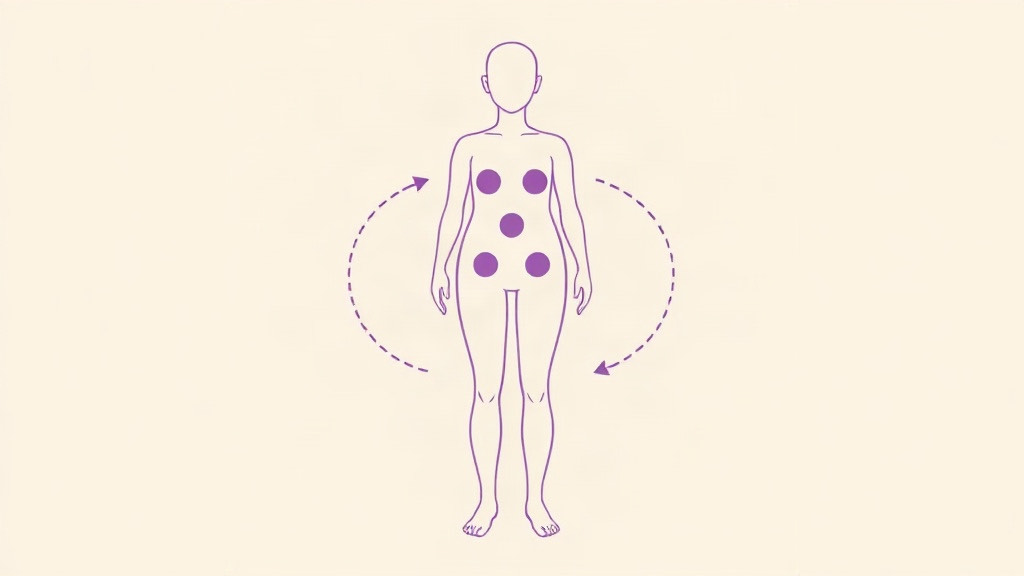
Ask someone about to start a GLP-1 medication what worries them, and the answer is usually the needle. Ask a nurse what actually causes trouble months down the road, and the answer is the skin. The needle part turns out to be quick and nearly painless for most people. The skin part depends on one small habit almost nobody is excited about: rotating where you inject.
Rotation is boring, free, and quietly important. Here is what the guidance says, why it exists, and how to make it automatic instead of a memory test. And when the injection is done, our guide to sharps disposal at home covers what to do with the used needle.
The three approved areas
GLP-1 medications are subcutaneous injections: they go into the layer of fatty tissue just under the skin, not into muscle. The product instructions for the major pens name three areas:
- The abdomen, keeping a buffer of about two inches around the navel
- The front of the thighs
- The back of the upper arms
All three are considered appropriate; the labels do not rank them. In practice, the abdomen and thighs are the easiest to reach on your own, while the back of the arm is simpler with another person's help. Your first fill usually comes with a demonstration from a pharmacist or nurse, and the printed instructions for use cover the technique for your specific pen. Follow those, not a website. If a site choice feels uncomfortable or confusing, that first-fill demonstration is the moment to ask; five minutes with a pharmacist beats a month of second-guessing.
Comfort counts for more than people admit here. The best site on paper is the one you will actually use calmly every week, and plenty of people settle into a favorite area and rotate within it. That is fine; the rotation that matters most is the one that actually happens.
What rotation prevents
Injecting in the same small spot again and again can irritate the skin, and over time it can lead to lipohypertrophy: a firm, sometimes lumpy thickening of the fatty tissue where injections keep landing. Injection site reactions such as redness or itching also appear on GLP-1 labels among the common, usually mild side effects, and constantly reusing one spot gives any irritation less time to settle.
The guidance that pairs with rotation is just as simple: do not inject into skin that is bruised, scarred, or tender. A fresh site each time keeps every injection going into healthy, comfortable tissue, which is the whole point. It is the same principle nurses teach for insulin and every other repeated subcutaneous medication; GLP-1 users simply get to learn it at the friendlier pace of one shot a week.
Rotation is prevention at its cheapest. It costs nothing, takes zero extra seconds once it is systematic, and spares you both the discomfort and the awkward conversation about why one patch of your stomach has gone firm.
Rotation is two decisions, not one
It helps to split the habit in two. First, rotate among areas: abdomen, thigh, arm, in whatever mix suits you. Second, rotate spots within an area: even if you are an abdomen loyalist, land each injection a little away from the last one rather than on the exact same point. Habits drift toward the same spot without anyone deciding it; the same chair, the same hand position, the same two square inches. A system breaks that drift.
The good news is that this is one of the rare pieces of health advice with no tradeoffs attached. Rotating costs nothing, hurts nothing, and asks for no willpower once a pattern carries it. The only requirement is deciding on the pattern once.
Simple systems that work
For a weekly injection, the classic system is the abdomen clock. Divide your abdomen into four quadrants around the navel (keeping that two-inch buffer) and move one quadrant clockwise each week: upper right, lower right, lower left, upper left. Four quadrants, four weeks, one clean lap per month, which happens to line up neatly with the four-week rhythm of most titration steps.
| Week | Site |
|---|---|
| Week 1 | Abdomen, upper right |
| Week 2 | Abdomen, lower right |
| Week 3 | Abdomen, lower left |
| Week 4 | Abdomen, upper left |
Prefer variety? Alternate regions instead: abdomen one week, left thigh the next, abdomen, right thigh, and repeat. Any pattern works as long as it is a pattern; the enemy is "wherever, again".
Thigh loyalists can run the same idea lengthwise: alternate legs each week, and let the spot drift along the front of the thigh rather than returning to the same freckle. If someone helps with your injections, the backs of the arms can join the loop the same way, alternating sides.
Daily injections raise the stakes, because seven shots a week visit skin far more often than one. If you are on Saxenda or Victoza, alternating sides every day and shifting zones through the week matters more, and our guide to tracking daily GLP-1 injections covers a rhythm built for that cadence.
 GLP 1 Tracker AppFree on the App Store. Log the site with every shot and let the app remember the rotation for you.
Get the app
GLP 1 Tracker AppFree on the App Store. Log the site with every shot and let the app remember the rotation for you.
Get the app
Log the site, every shot
Every rotation system shares a single point of failure: remembering where the last one went. "Left thigh or right thigh, three Thursdays ago?" is not a question memory answers reliably, and a system you cannot verify quietly collapses back into habit. Paper charts and memory games both work for a few weeks; then travel, a schedule change, or ordinary life interrupts, and the certainty ends.
The fix is to make the site part of the log. GLP 1 Tracker App includes injection site notes on every dose you record, so the answer to "where was the last one?" is a glance, not an act of recall. It fits naturally into the shot-day ritual of recording the time, the dose, the site, and how you felt, which our shot tracker guide walks through in full. And if a particular site ever does act up, a log that pairs sites with your side effect diary shows the pattern instead of leaving you guessing.
If you are just starting out, this is the easiest habit to build from shot one, before any drift sets in. Our guide to your first week on a GLP-1 folds site logging into the day-one routine.
When to bring your skin into the conversation
Mention it to your prescriber or pharmacist if a site stays red, swollen, or tender well after an injection, or if you notice firm or lumpy patches developing where you inject. None of that is cause for panic, but it is exactly the kind of observation worth raising at a follow-up, and a site log makes the conversation specific. As with anything on these medications, symptoms that feel severe deserve prompt medical care rather than patience.
Pharmacists are an underused resource here too: rotation questions, technique refreshers, and pen quirks are all fair game at the counter, no appointment required.
The takeaway
Three approved areas, a fresh spot every time, never into bruised, scarred, or tender skin. Pick a pattern simple enough to survive a busy week, the abdomen clock or an alternating loop, and write the site down with every shot so the system checks itself. It is thirty seconds of diligence per week for skin that stays comfortable through what may be a long run of injections. Boring, free, and worth it.
Frequently asked questions
Where are you supposed to inject GLP-1 medications like Ozempic or Mounjaro?
GLP-1 medications are subcutaneous injections, and the product instructions name three areas: the abdomen, keeping a buffer of about two inches around the navel, the front of the thighs, and the back of the upper arms. The labels do not rank them. Do not inject into skin that is bruised, scarred, or tender, and follow the printed instructions that come with your specific pen.
Why do you need to rotate injection sites?
Injecting the same small spot repeatedly can irritate the skin and, over time, lead to lipohypertrophy, a firm or lumpy thickening of the fatty tissue where injections keep landing. Rotating means every shot goes into healthy, comfortable tissue and gives any irritation time to settle. Injection site reactions such as redness or itching appear on GLP-1 labels among the common, usually mild side effects.
Is it OK to always inject in my stomach?
Staying loyal to one area is fine as long as you rotate spots within it, landing each injection a little away from the last rather than on the same point. A classic system is the abdomen clock: divide the abdomen into four quadrants around the navel, keeping the two-inch buffer, and move one quadrant clockwise each week for one clean lap per month.
Which injection site works best for GLP-1 shots?
The labels treat all three approved areas as appropriate and do not rank them. In practice, the abdomen and thighs are the easiest to reach on your own, while the back of the arm is simpler with another person's help. The best site is the one you will use calmly and consistently; a pharmacist can walk you through technique at your first fill.
How do I keep track of which injection site I used last?
Make the site part of the log instead of a memory test. GLP 1 Tracker App includes injection site notes on every dose you record, so the answer to where the last shot went is a glance, not an act of recall. Logging the time, dose, and site together each shot lets any rotation pattern check itself, which is where paper charts usually fail.