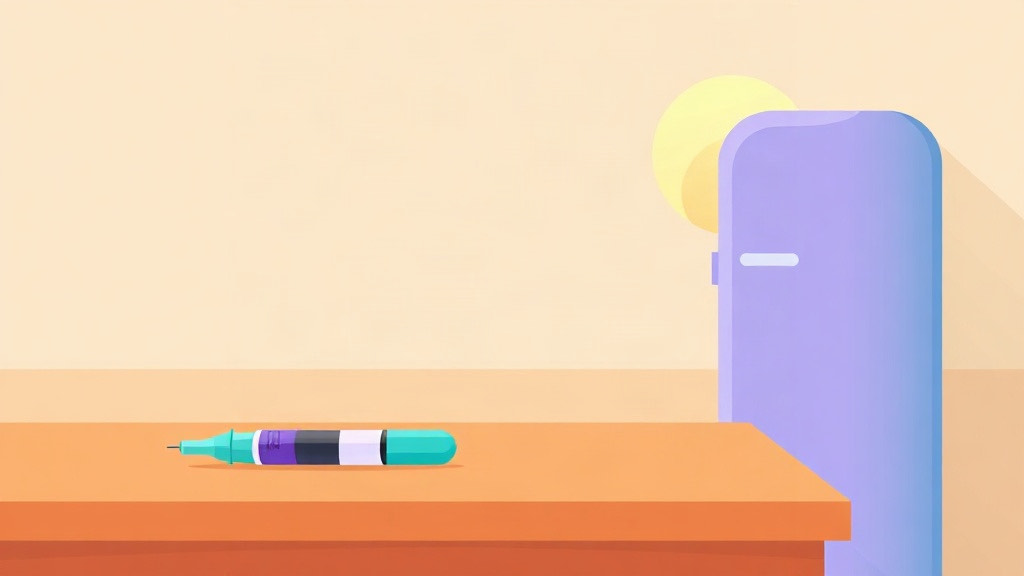
You come into the kitchen, and there it is on the counter where you left it last night. The fridge door is shut. The pen has been sitting out for eight hours, or eleven, or you genuinely do not know.
The first thing worth saying is the thing most pages will not say: we cannot tell you whether that pen is fine, and we are not going to pretend otherwise. What we can do is hand you the two questions that actually determine the answer, so that the person who can answer it has what they need in under a minute.
The two questions that actually matter
Storage guidance for these medications comes down to two variables, and almost every anxious search on this topic is really about one of them.
- Time. How long has this pen been out of refrigeration in total, across its whole life, not just since last night.
- Temperature. Did the room stay within the label's ceiling, or did the pen sit somewhere genuinely hot.
There is a third question that only applies in the other direction, freezing, and it is the one place the labels give an unambiguous answer. We will get to it. Start with time.
Question one: total time out of the fridge
Here is the detail that trips almost everyone up. The room-temperature allowance printed on these labels is cumulative time out of refrigeration. It is not a clock that resets every time the pen goes back in the cold.
So the honest number is not "eleven hours." It is eleven hours plus the afternoon it spent in a gym bag two weeks ago, plus the evening it sat out while you were on the phone, plus the day it traveled with you. If the pen has been in use for a while, those stretches add up in ways that are easy to underestimate and impossible to reconstruct from memory.
This is the number a pharmacist will ask for, and "I am not sure" is a legitimate answer as long as you say so rather than guessing low. It is also the number a dose log quietly answers for you, which we come back to at the end.
Question two: how warm was the room
The time allowance assumes the temperature stayed within a ceiling. Commonly published labels put that ceiling at or below 30 C (86 F).
A night on a kitchen counter in an air-conditioned house is a different situation from all of the following, and it is worth being precise about which one you are actually in:
- A closed car, which can climb far past 30 C within an hour on a mild day, let alone a hot one.
- A sunny windowsill or a countertop in direct afternoon light, where the local temperature is nothing like the room's average.
- A room during a heat wave, or a house where the cooling was off while you were away.
- Near a stove, a radiator, a dishwasher vent, or on top of an appliance that runs warm.
If the pen went past the ceiling, the days-based allowance is no longer the relevant rule, and the question changes shape entirely. That is not a reason to panic, but it is a reason not to reassure yourself with a number that was never meant to cover a hot car. Describe what actually happened to your pharmacist instead of estimating a temperature you did not measure.
The other direction: freezing
Cold is the one place the labels stop hedging. These medications must never be frozen, and a pen that has been frozen should not be used, even if it thaws and looks completely normal.
This matters more often than people expect, because home refrigerators freeze things by accident all the time: the back wall, the area under a freezer vent, a shelf set too cold. Our guide to storing pens at home covers where in the fridge a pen actually belongs and why the door and the back wall are both the wrong answer.
If you think a pen may have frozen, treat it the same way you would treat the heat question: set it aside, do not inject it, and ask.
 GLP 1 Tracker AppFree on the App Store. A date-stamped log of every shot, so the date your pen came out of the fridge is a fact, not a guess.
Get the app
GLP 1 Tracker AppFree on the App Store. A date-stamped log of every shot, so the date your pen came out of the fridge is a fact, not a guess.
Get the app
What the labels publish
The published allowances run from about three weeks to about eight weeks depending on the product, and they differ in what they are counted from, so the exact number for your medication is worth reading rather than recalling. Our guide to storing pens at home sets the figures out product by product. They are context for your conversation, not a verdict on your pen.
What matters most for last night is the ceiling those allowances share. Every one of them is written for a room at or below 30 C (86 F). A kitchen that stayed in that range is the situation the label anticipated. A room that ran hotter is a different question, and one the time allowance was never meant to answer.
One product-specific point is worth knowing before you act on instinct: the tirzepatide labels say a pen should not go back in the refrigerator once it has been stored at room temperature. If you use Mounjaro or Zepbound, putting the pen back may not be the right move, which is one more reason to ask before you do anything.
Why the pharmacist is the right call
It can feel like too small a thing to bother a professional with. It is not. Pharmacists field this exact question constantly, and there are concrete reasons they are the right stop rather than a forum thread or an article:
- They can see the exact product, strength and presentation you have, including differences between pen types that a general article cannot account for.
- They have the current label in front of them, and labels change.
- They can usually answer immediately, where a prescriber callback may take a day, and a pharmacy is often reachable in the evening or on a weekend.
- If a pen does need replacing, they are the people who handle what comes next anyway.
Call the pharmacy that filled the prescription if you can, since they know what they dispensed. Have the carton in your hand, along with your two answers: total time out, and how warm the room was.
What to do while you wait, and how to avoid a repeat
Two temptations show up in the gap between finding the pen and reaching someone, and both are worth resisting.
Do not inject a pen you are unsure about. The uncertainty is exactly the reason to ask first. And do not throw it out either. Discarding medication on a guess costs money, may cost you doses you cannot quickly replace, and takes away the one thing the pharmacist may want to look at. Put the pen back in the refrigerator unless you are told otherwise, keep the carton with it, and wait for an answer from someone qualified to give one.
It is also worth remembering that this is rarely as time-critical as it feels at 7am. Weekly medications have published late-dose windows measured in days, which our missed dose guide lays out in full. There is almost always room for a phone call before anything has to be decided.
As for the next one: the reason this morning is stressful is not really the pen, it is the missing information. You do not know how long it has been out in total because nothing wrote it down. That is a solvable problem. A date-stamped shot log tells you exactly when the current pen started being used and how many injections it has seen, so "total time out of the fridge" becomes arithmetic instead of archaeology, and a shot-day reminder makes putting the pen back part of the same two-minute ritual that includes logging it. The same habit is what keeps travel storage honest too, as our travel guide describes.
One pen on a counter is not a catastrophe. It is a question with two inputs and one right person to ask.
Frequently asked questions
I left my Ozempic pen out overnight. Is it still good?
We cannot answer that for your pen, and we will not guess. Only your product's own label and a pharmacist who can see exactly what you have can answer it. What you can do is gather the two facts they will ask for: the total time that pen has spent out of refrigeration, counting every previous stretch and not only last night, and how warm the room actually got. Then call the pharmacy.
How do I work out how long my pen has been out if I never wrote it down?
You reconstruct it rather than guess at it, and then you say out loud that it is a reconstruction. Work backward through the dates you can actually anchor: the day the pen came home from the pharmacy, the day you first used it, any trip it went on. A dose log makes this far easier, because each logged shot is a date you do not have to remember. Tell the pharmacist your best reconstruction and how confident you are in it. An honest "at least three days, possibly five" is far more useful to them than a confident number you invented.
What if my GLP-1 pen was left in a hot car or in direct sun?
Heat above the label's ceiling is a different question from a night on a cool kitchen counter, and the published time allowance assumes the temperature stayed within that ceiling. Commonly published labels put it at or below 30 C (86 F), and a closed car, a sunny windowsill or a room during a heat wave can pass that quickly. Describe the situation honestly to your pharmacist instead of estimating a temperature you did not measure.
What if the pen froze instead of getting warm?
Freezing is the one direction where the labels agree without hedging: these medications must never be frozen, and a pen that has been frozen should not be used even if it thaws and looks completely normal. That includes a pen pushed against the back wall of a refrigerator or left under a freezer vent. Set it aside, do not inject it, and ask your pharmacist what to do next.
Should I skip my dose while I wait to hear back from the pharmacy?
That is a question for your pharmacist or prescriber, not for an app or an article, and it is usually less urgent than it feels in the moment. Weekly GLP-1 medications have published late-dose windows measured in days, so there is normally time to make a phone call before deciding anything. What you should not do is inject a pen you are unsure about, or throw medication away, on a guess.