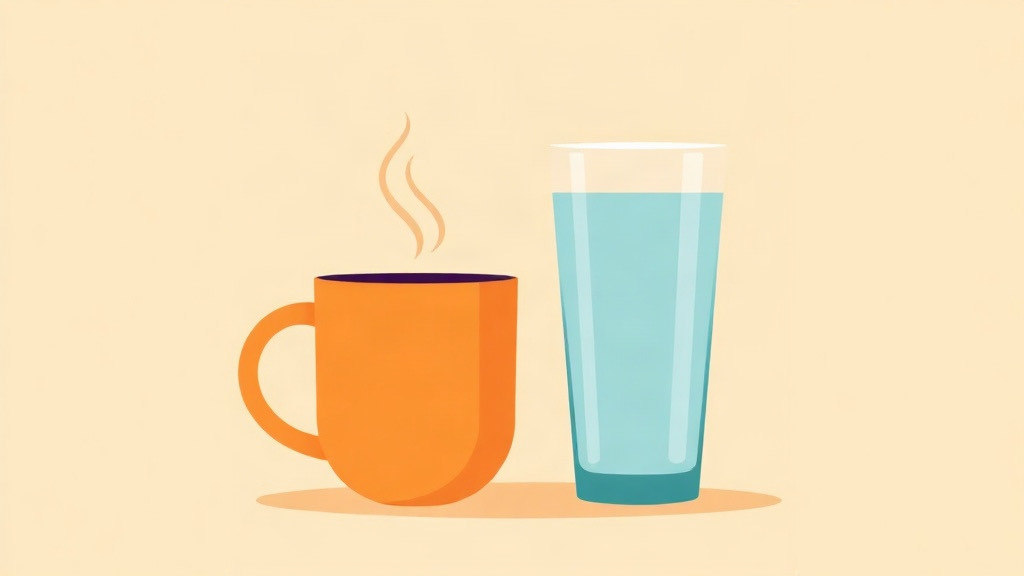
Coffee is one of the first things people quietly worry about losing when a GLP-1 prescription starts, and the worry is usually misplaced. There is no contraindication between caffeine and semaglutide in the FDA prescribing information, and no direct drug interaction to plan around. Coffee is not off limits.
What can change is how coffee feels. These medications slow the stomach down, and a slower stomach sometimes responds differently to a hot, acidic, stimulating drink taken before anything else in the day. That is a tolerance question, not a rule, and it varies enormously between people. This article covers the mechanics behind it, the one place where timing genuinely is a rule (oral semaglutide), the hydration angle almost nobody thinks about, and a simple two week experiment that answers the only question that actually matters: is coffee a problem for you specifically?
The short answer, before the nuance
For most people on a GLP-1, morning coffee carries on exactly as it did before. Caffeine does not appear as an interaction in the labeling for these medications, and nothing about starting one requires giving it up. If coffee has never bothered you and still does not, there is no hidden reason to change the habit.
What a minority of people report instead is a shift in tolerance, concentrated in predictable places: the first few weeks of treatment, the days after a dose increase, and mornings when coffee arrives before food. The friction there is mechanical rather than chemical, which is worth understanding, because understanding it points straight at the fix.
Why coffee can sit differently on a slower stomach
GLP-1 medications slow gastric emptying. Food and liquid leave the stomach more gradually than they used to, which is part of how these drugs produce fullness and part of why nausea is the most commonly reported side effect on the class, typically worst after a dose increase and tending to ease over the following weeks.
Caffeine pulls in a slightly different direction. It stimulates gastric acid secretion and gut motility. Land that on a stomach that is already emptying slowly and the result, for some people, is more noticeable than it used to be: a sour or over-full feeling, a faint queasiness that sits through the first hour, or reflux that was never previously an issue.
Notice how specific the risky version is. Coffee before food, in the first month, on the day after a shot, at the top of a new dose step, is the high friction version of the habit. Coffee after breakfast, three months in, at a steady dose, is often completely unremarkable. The most commonly suggested adjustment is exactly that simple: have coffee with or after food rather than on an empty stomach, and see whether the difference is real for you.
If reflux is the symptom that turns up, the wider pattern is worth reading about in our guide to heartburn and reflux on a GLP-1, because a slower stomach changes more than one habit. If it is nausea, the comfort measures commonly suggested for the class are collected in our nausea guide.
The one hard rule: Rybelsus and the 30 minute window
There is exactly one place where coffee is not a matter of personal tolerance but a timing rule printed in the label, and it belongs to oral semaglutide.
Per the prescribing information, Rybelsus is taken on an empty stomach after waking, with plain water only, up to about 4 ounces (120 ml). After swallowing the tablet you wait at least 30 minutes before any food, any other drink, or any other oral medication.
Coffee is another drink. It waits.
That includes black coffee with nothing added, and it includes tea, juice, sparkling water, and the protein shake you were going to have on the way out. The rule exists because oral semaglutide is absorbed in a narrow and fussy window, and the timing instructions are what protect that absorption. Shortening the wait is not a small liberty; it is the part of the routine the whole tablet depends on.
The practical shape of a Rybelsus morning, then, is a small rearrangement rather than a sacrifice. Wake, take the tablet with a little plain water, and then do the things that fill 30 minutes anyway: shower, dress, walk the dog, get the kids moving. Coffee is what you arrive at when the window closes, not the thing you swallow the tablet with. Plenty of people find it becomes the most reliable half hour of their morning. Our guide to tracking Rybelsus covers the rest of the daily rules and why the daily cadence changes how you log.
One habit worth building: set the tablet reminder, then set a second alarm on your phone for the end of the 30 minutes, so the clock is not something you have to hold in your head before caffeine has arrived.
 GLP 1 Tracker AppFree on the App Store. Dose reminders, a side effect diary with severity, and water logging in one private app.
Get the app
GLP 1 Tracker AppFree on the App Store. Dose reminders, a side effect diary with severity, and water logging in one private app.
Get the app
Caffeine, fluid, and a thirst signal that went quiet
Caffeine is a mild diuretic. On its own, in someone who drinks coffee habitually, that effect is modest and not a reason to avoid it. On a GLP-1 it lands on top of something else, and the combination is worth watching.
These medications blunt appetite, and for many people they blunt thirst cues along with it. Fluid intake falls without any decision being made to lower it. You are not refusing water; you are simply never being reminded to want it. General guidance commonly cited for adults is roughly 2 to 3 liters of fluid daily, and hydration is also part of the picture for constipation, dizziness and headaches, which is why we gave it its own article.
Where coffee fits in that: for regular drinkers it does contribute fluid rather than working against the total. The failure mode is not coffee itself, it is coffee standing in for everything else. Three cups and nothing else is a very common GLP-1 morning, and it is a thin one.
The habit that fixes it costs nothing: a glass of water beside every cup of coffee, poured at the same time. Water logged in the app turns the whole thing from a vague intention into a number you can look at by mid-afternoon, when there is still time to do something about it.
Steady beats sudden
The other common caffeine mistake on a GLP-1 is a well-intentioned one: deciding to quit abruptly in week two because something feels off.
Abrupt changes in caffeine intake can bring headaches of their own. Headaches are already a frequent early complaint on these medications, usually tied to eating and drinking less rather than to the drug acting on your head directly, as our guide to headaches on a GLP-1 explains. Change two things at once and you lose the ability to tell which one you are feeling.
So if you want to cut back, taper gradually rather than stopping cold, and give it a couple of weeks before drawing conclusions. If you want to keep coffee, the useful discipline is consistency: roughly the same amount at roughly the same time each day. That turns caffeine into a constant in your data instead of a variable, which is what makes everything else in your log readable.
The two week experiment
Whether coffee is a trigger for you personally is an easy thing to find out and a genuinely hard thing to guess. Memory is terrible at this. It notices the two bad mornings and forgets the twelve ordinary ones.
So run it as an experiment. For two weeks, note three things a day:
- When you had coffee and roughly how much
- Whether it came before or after food
- Any nausea or reflux, with a severity rating, and what time it started
Then read the two weeks together and look for coincidence rather than conviction. A few patterns show up often. Symptoms on the days coffee arrived first, and not on the days it followed breakfast, is the most actionable result there is: keep the coffee, move it. Symptoms clustered in the two or three days after your shot regardless of when coffee happened points at the dose rhythm rather than the drink. And a fortnight of nothing at all is also a result: coffee is fine, carry on.
This is the kind of question a side effect diary answers well and memory answers badly. In GLP 1 Tracker App, side effects are logged with severity, food and drink sit in the same daily log as protein, water and fiber, and your doses run along the same timeline, all in the free tier. Because dose day is in the same record, the coffee question and the titration question stop being tangled together. Premium adds 90-day side effect trends if you want to watch the pattern over a longer stretch. Our guide to tracking side effects covers what clinicians actually ask to see.
When it is not the coffee
A few things deserve to be pulled out of a coffee conversation entirely, because attributing them to a drink delays the response they need.
Severe abdominal pain is never a wait and see symptom on a GLP-1; our article on severe abdominal pain explains why it is a same day call. Persistent vomiting, or being unable to keep fluids down, belongs to sick day thinking rather than to caffeine. Reflux that wakes you at night, or that has become a daily feature rather than an occasional one, is a conversation with your prescriber.
Coffee is a reasonable suspect for mild, predictable, morning-shaped discomfort that tracks with when you drank it. It is not an explanation for anything severe, anything escalating, or anything that persists once you have moved it after food.
The takeaway
Caffeine and GLP-1 medications have no interaction to negotiate, and coffee stays on the table. The realistic adjustments are small: have it with or after food if your stomach has become more particular, keep the amount steady rather than swinging, pour water alongside it, and if you take Rybelsus, respect the empty-stomach window and let the coffee wait its 30 minutes. Then log two weeks of coffee against two weeks of symptoms and let the data settle the argument, because the answer is personal and your log is the only place it exists.
Frequently asked questions
Can I drink coffee while taking Ozempic or Wegovy?
Yes. There is no contraindication between caffeine and semaglutide in the FDA prescribing information, and no direct drug interaction to work around. Coffee is not off limits on a GLP-1. What some people notice is a change in tolerance rather than a rule: because these medications slow gastric emptying, coffee on an empty stomach can feel more acidic or more nauseating than it used to, especially early on.
How long after taking Rybelsus can I drink coffee?
At least 30 minutes. Per the prescribing information, Rybelsus is taken on an empty stomach with plain water only, up to about 4 ounces or 120 ml, and you wait at least 30 minutes before any food, any other drink, or any other oral medication. Coffee counts as another drink, including black coffee, so it waits until that window has fully passed.
Why does coffee upset my stomach now that I am on a GLP-1?
The friction is mechanical rather than chemical. GLP-1 medications slow how quickly the stomach empties, while caffeine stimulates gastric acid and gut motility. On a stomach that is already emptying slowly, that combination can make nausea or reflux more noticeable, particularly on an empty stomach and particularly in the first weeks or after a dose increase. Having coffee with or after food is commonly suggested.
Does coffee count toward my water intake on a GLP-1?
For habitual coffee drinkers it does contribute fluid, though caffeine is a mild diuretic. The bigger issue on a GLP-1 is that appetite and thirst cues both fall, so total fluid intake quietly drops. General guidance commonly cited is roughly 2 to 3 liters of fluid daily. The practical habit is to let coffee join your water rather than replace it: a glass of water beside every cup.
Should I quit caffeine when starting a GLP-1?
There is no general reason to. If anything, abrupt swings in caffeine intake can bring headaches of their own, and headaches are already a common early complaint on these medications, which makes it harder to tell causes apart. Keeping intake roughly consistent day to day turns caffeine into a constant in your log rather than a variable. If you want to cut back, tapering gradually is the gentler route.