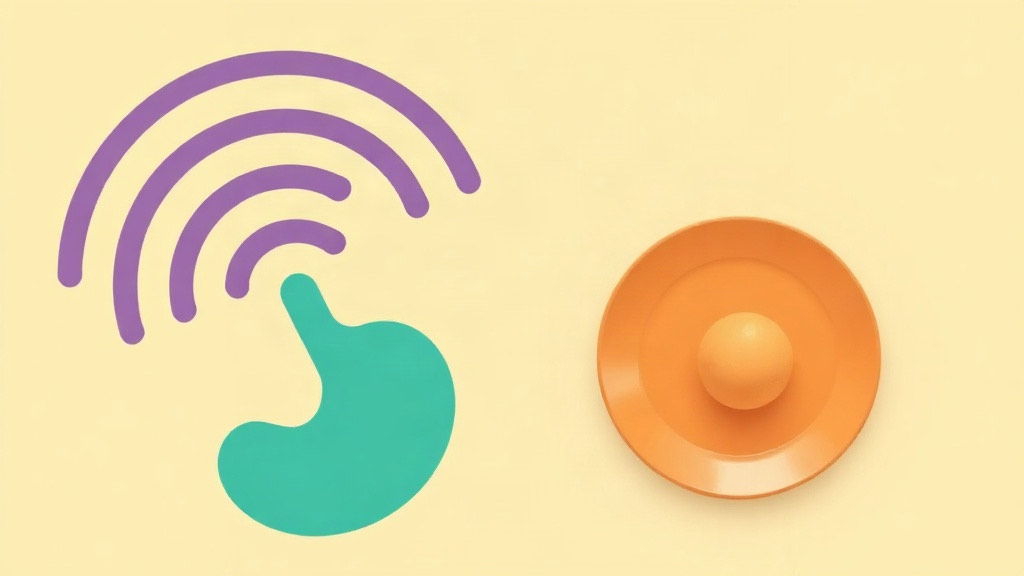
Most people start a GLP-1 braced for hunger to change, and usually it does. What catches them out is the other signal, the one almost nobody thinks to watch until it goes wrong.
The scene is familiar enough to be a genre. A normal-sized dinner, eaten at a normal speed, in normal company. Nothing feels excessive while it is happening. Twenty minutes later, on the sofa, you are uncomfortably full, and the obvious question follows: what was different about that meal?
Nothing, is the honest answer. That is exactly the problem.
Hunger and fullness are two signals, not one dial
It is convenient to picture appetite as a single slider running from empty to stuffed, hunger at one end and fullness at the other. Convenient, and not how it works.
They are separate signals. They come from different sources, travel at different speeds, and are not obliged to take turns. You can be genuinely not hungry and also not full. You can be hungry at the start of a meal and done with it four bites later, which on a GLP-1 is routine rather than strange.
Almost all the attention goes to hunger, for an understandable reason: hunger asks for something, and requests get noticed. Fullness makes no request. It is a report, quietly filed, and most of us ignore it until it turns uncomfortable enough to be unignorable. That costs little while the report arrives on the schedule you grew up with. It costs a lot when the schedule moves.
What being full actually is
There is a word for the sense of what is happening inside your own body: interoception. It covers the internal reports you already read without thinking, like a heartbeat after stairs or a bladder that needs attention. Hunger and fullness are two of them.
The fullness report is assembled from two things.
- Stretch. As the stomach and intestine fill, mechanoreceptors in their walls register the physical stretching. This is the fast part, and it is about volume rather than about food.
- Nutrient detection. As food moves out of the stomach and into the small intestine, cells lining the gut detect what has arrived and release gut hormones in response. GLP-1 is one of those hormones, which is where the medications get their name.
The second half is the interesting one, because it is downstream. Food has to leave the stomach and reach the intestine before anything there can detect it. Even with no medication involved that takes time, which is why the old advice to wait twenty minutes before deciding you are still hungry has always been sound.
So fullness is not a live reading of what is on your plate. It is a report about a process still in progress, and reports lag. Everything below is a consequence of that one fact.
What a GLP-1 changes about the timing
These medications do something well documented and easy to state: they slow gastric emptying. Food leaves the stomach more slowly than it used to.
Delayed gastric emptying is linked to increased feelings of fullness, and that fullness lengthens the time until the next meal and lowers overall intake. This is not a side effect that snuck in. It is a large part of how the medication does its job.
Notice what it does to the shape of the signal rather than its size. Because the stomach holds food longer, fullness builds sooner in the meal and stays up afterward. GLP-1 receptor agonist treatment can genuinely alter the interoceptive experience of eating, and enhanced fullness through delayed gastric emptying is a well-described part of that.
| The fullness signal | Before | On a GLP-1 |
|---|---|---|
| When it first registers | Later in the meal | Earlier, sometimes after a few bites |
| How long it stays | Eases over a few hours | Commonly described as lasting longer |
| How fast the stomach empties | Its usual pace | Slower, a known effect of this class |
| The stopping cue that fits | Full | No longer hungry |
One thing muddies the picture early on. Nausea is the most common side effect of this class and is typically worst in the days after a dose increase, and uncomfortable fullness and mild nausea are hard to tell apart at first. Our guide to nausea patterns worth tracking covers that timing.
 GLP 1 Tracker AppLog food, protein and water alongside your doses and see how the week actually went. Free, private, no account.
Get the app
GLP 1 Tracker AppLog food, protein and water alongside your doses and see how the week actually went. Free, private, no account.
Get the app
Why a normal portion overshoots
Now the sofa moment makes sense, and it is not a story about willpower or about overeating in any sense you would recognize from before.
You ate an old amount, at an old speed, against a new signal. Two things stacked. The point at which you had enough arrived earlier in the meal than it used to, so you passed it near the halfway mark without noticing. And because the stomach empties more slowly, everything eaten after that point is still there, announcing itself, for longer.
The habit is the culprit, and it is worth naming which habit. Very few people eat to a fullness signal. They eat to a plate, to a clock, to the end of an episode, or to the pace of whoever else is at the table. Every one of those proxies was calibrated over years to a signal that arrived at a particular moment. Move the moment and they quietly stop working, without announcing it.
This is distinct from the mental side of appetite. If what changed for you is the background chatter about eating going quiet, that is food noise. If it is eating past fullness on hard days specifically, that is a different track again, covered in stress, appetite and GLP-1s. This piece is about the mechanical signal and the fact that its clock has been reset.
Relearning the signal
The good news about a timing problem is that it has a timing solution. Eating more slowly is the one lever that reliably helps, and for a specific reason rather than as general advice: the fork is moving faster than the report. Slow the fork and the report catches up while there are still bites left to decline.
- Put the fork down between bites. Not as a discipline exercise: it is the cheapest way to add minutes to a meal without adding effort.
- Serve less and allow a second trip. A walk back to the kitchen is easier to undo than half a plate you no longer want.
- Pause once, partway through. Thirty seconds of doing nothing near the middle of a meal is often enough for the answer to change.
- Stop at no longer hungry, not at full. On these medications, full is frequently the overshoot line rather than the target.
- Treat not hungry as a valid ending. Leaving food is a decision, not a failure to finish.
The last one takes longest, because it feels like breaking a rule. The rule was written for a body that emptied its stomach at a different rate. Meals away from home are harder still, since portions and pacing are set by someone else; our notes on eating out on a GLP-1 deal with that directly.
A quiet appetite still needs feeding
Here is the honest limit on all of that. Feeling full and being nourished are not the same thing, and a medication that produces the first does not deliver the second. A smaller intake means every bite carries more responsibility than it used to.
- Protein. Guidance commonly cited for people on GLP-1 medications is roughly 1.0 to 1.5 g per kilogram of body weight daily. When the window before fullness is short, spend it on protein first and treat the rest of the plate as optional. Our guide to protein goals on GLP-1s covers the targets.
- Fluids. A commonly cited general target is around 2 to 3 L daily, and these medications blunt thirst cues for some people, so another signal you would normally rely on has gone quiet. Drinking on a schedule rather than on demand is the usual fix; see why hydration matters more on a GLP-1.
This is where writing things down earns its keep, because a small day does not feel like a small day from the inside. Fullness is a convincing witness, and it will tell you that you ate plenty on a day the protein total disagrees with. GLP 1 Tracker App logs food, protein, water and fiber alongside your doses, with saved templates for meals you repeat, so the difference between feeling fed and being fed shows up as a number. A free-text note attaches to dose, weight and side effect entries if you want to record how a week landed.
One more limit belongs here, and it is the important one. All of the above assumes the ordinary version of this: a smaller appetite and a signal arriving at an unfamiliar time, both of which you can adapt to. Some experiences are not that, and they are not to be pushed through quietly. Losing the hunger signal entirely, being unable to eat, vomiting that does not settle, severe or persistent abdominal pain, or weight coming off at a rate that alarms you all belong in a conversation with your prescriber rather than in a self-management plan. So does being unable to get near protein and fluids for days at a stretch. That is not a dramatic escalation. It is the ordinary use of the person who prescribed the medication.
The takeaway
Hunger and fullness were always two signals rather than one, and fullness was always a delayed report rather than a live reading. A GLP-1 does not invent either problem. It changes the timing, and enough that habits built over decades stop landing where they used to.
The adjustment is smaller than it sounds. Slow down enough for a slower signal to arrive, stop at no longer hungry rather than at full, and make sure a quieter appetite is still being fed. The signal has not become unreliable. It moved, and it can be read again.
Track what a small appetite actually deliversProtein, water, food and doses in one free log. Nothing leaves your phone.
Download
Frequently asked questions
Why do I get full so fast on a GLP-1?
Because these medications slow gastric emptying, so food leaves the stomach more slowly and the stomach stays fuller for longer. Delayed gastric emptying is linked to increased feelings of fullness, which lengthens the time until the next meal and lowers overall intake. The size of the meal has not changed. The point in the meal where your body reports fullness has moved earlier.
Why do I feel overfull twenty minutes after a normal-sized meal?
Fullness is a delayed report rather than a live reading. Part of it comes from stretch in the stomach, and part from cells in the small intestine detecting nutrients once food arrives there, which now happens more slowly. So a portion that felt fine at the table can register as too much by the time the whole signal has landed. Slowing down is what closes that gap.
Does eating slowly actually help on a GLP-1?
It is the one habit that genuinely fits the change. The problem is usually not the size of the meal but the speed of the fork relative to a slower signal, so slowing down lets fullness arrive while there are still bites left to decline. Putting the fork down between bites and pausing partway through the plate are the usual practical versions.
Should I stop eating when I feel full or when I am no longer hungry?
Many people on these medications find that waiting for full is already an overshoot, because full now arrives later than the point where they had enough. The moment hunger simply goes away is an earlier and more comfortable place to stop. Leaving food on the plate because you are no longer hungry is a reasonable decision, not a failure to finish.
How do I eat enough protein if I feel full after a few bites?
By spending the small window on protein first, before the rest of the plate. Guidance commonly cited for people on GLP-1 medications is roughly 1.0 to 1.5 grams of protein per kilogram of body weight daily, and general hydration targets of about 2 to 3 liters still apply even though thirst cues can be blunted. If you consistently cannot get close, raise it with your prescriber or a dietitian.