Ask almost anyone to name the hormone behind modern weight medications and you get one answer. GLP-1 has become shorthand for the entire subject, which is fair enough given what is actually in pharmacies. But GLP-1 was never the only fullness signal the body sends, and it is not the only one that has been turned into a medication.
Amylin is the other one. It has been studied for decades, it has had an approved analogue since 2005, and it is the reason the name CagriSema has two halves. It is also, once you look at what it does, oddly familiar.
A second hormone leaves the pancreas with insulin
Amylin is secreted by the beta cells of the pancreas: the same cells that make insulin, releasing both in response to the same event. That single detail is the starting point for everything else.
Amylin does not arrive instead of insulin, and it is not a backup that appears when something goes wrong. It travels with insulin, every time, as the second component of one response. It is worth noticing that pramlintide, the amylin analogue that reached the market, is approved for use alongside insulin rather than on its own, which fits the way the two hormones move together in the body.
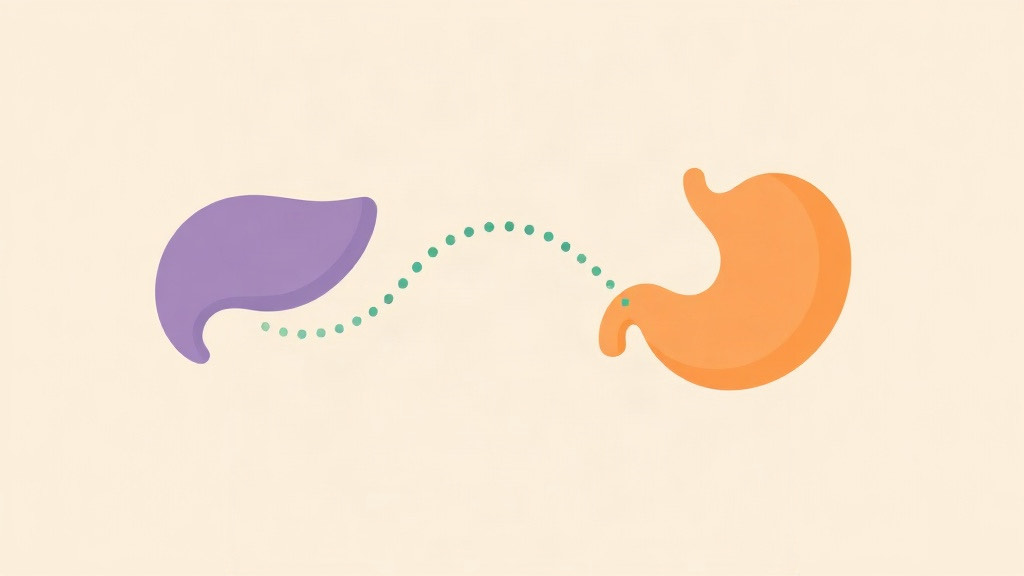
That makes amylin a very different kind of signal from the one most people on these medications have read about. GLP-1 is a gut hormone, released by L-cells lining the intestine when food arrives. Amylin comes from the pancreas, released with the insulin response that follows. Two organs, two triggers, two receptors, one meal.
The timing is worth pausing on, because it shapes what an amylin signal is for. GLP-1 goes out early, as food shows up in the gut. Amylin goes out with insulin, which is to say slightly later, once the body is already dealing with the glucose that food produced. Neither is a constant background hum. Both are messages tied to a specific event, which is exactly why the natural versions are built to be brief, and exactly why turning either of them into a medication was a chemistry problem before it was anything else.
The overlap with GLP-1 is bigger than you would expect
Here is where the story becomes interesting rather than merely tidy. Amylin does three things that anyone who has read about GLP-1 will recognize on sight. It inhibits glucagon secretion. It delays gastric emptying. And it acts as a satiety signal, contributing to the sense of having had enough.
That is not a partial resemblance. Three of the four jobs usually listed for GLP-1 have an amylin counterpart, reached from a different direction and through a different receptor.
| Amylin | GLP-1 | |
|---|---|---|
| Where it comes from | Beta cells of the pancreas | L-cells in the intestine |
| When it is released | Together with insulin | In response to eating |
| Glucagon | Inhibits its secretion | Inhibits its secretion |
| The stomach | Delays gastric emptying | Slows gastric emptying |
| Appetite | Acts as a satiety signal | Contributes to satiety |
| Long-acting analogue | Cagrilintide, investigational | Semaglutide and others, approved |
Why a body would carry two hormones doing such similar work is a question biology rarely answers politely. Overlapping systems are normal, and appetite in particular is regulated by a crowd of signals rather than a single switch; GIP and glucagon are two more names in that crowd.
The more answerable question is what the overlap means for medications, and there the reasoning is easy to follow. Two separate pathways producing a similar effect means one can be engaged without pushing the other harder, which is a genuinely different proposition from simply raising a dose. Whether that translates into better outcomes for people is settled by trials rather than by diagrams, and the careful reading of the one combination tested at scale lives in our CagriSema guide.
 GLP 1 Tracker AppFree on the App Store. Real dose ladders, an educational level curve and a side effect diary, all on your phone.
Get the app
GLP 1 Tracker AppFree on the App Store. Real dose ladders, an educational level curve and a side effect diary, all on your phone.
Get the app
The analogue that has been around for twenty years
The part of this story that surprises people is that an amylin analogue is not new at all.
An analogue, in this context, is a molecule deliberately built to resemble a natural hormone closely enough to engage the same receptor, while differing in the ways that matter for making a medicine: stability in a vial, and survival in the bloodstream. Pramlintide, sold as Symlin, was the amylin version. The FDA approved it in March 2005 for people with type 1 and type 2 diabetes, as an adjunct to insulin therapy.
2005 was a notable year for this corner of medicine. It is also when exenatide became the first GLP-1 receptor agonist approved by the FDA, a molecule that came, improbably, from gila monster venom. Two hormone-based approaches to blood sugar cleared the same regulator in the same year, and only one of them went on to become a household word.
The reason is not mysterious. Pramlintide requires three injections a day, because its half-life is short. Three daily injections, on top of insulin, is a demanding thing to hand someone, and it sets a hard ceiling on how widely a medication gets used no matter how sound the biology behind it is.
Why making it last was the obvious next move
If you have followed how the GLP-1 medications developed, you already know what happened next, because the field ran into exactly the same wall and climbed it the same way.
A peptide hormone that disappears in minutes or hours can be turned into a practical medication in two moves: change the molecule so the enzymes that dismantle it cannot get a grip, and attach a fatty acid chain that binds to albumin, an abundant protein in the blood, which both shelters the molecule and slows how quickly the kidneys clear it. That is the engineering that turned a two-minute hormone into a weekly injection, and we walk through it in plain language in our guide to why some GLP-1s are weekly and others daily.
Cagrilintide is what that approach produced on the amylin side: a stable, lipidated long-acting amylin analogue, meaning it carries the kind of fatty acid modification that extends a peptide's working life, developed for obesity rather than for diabetes. It produced weight loss when given on its own and when given in combination with semaglutide, which is the finding that put the two molecules into a single pen.
Notice that the destination changed along the way. Pramlintide was approved as a diabetes medication used with insulin; cagrilintide was developed for obesity, and the pairing it ended up in is built around a weight management dose of semaglutide. That is the same migration the GLP-1 molecules made, from blood sugar to body weight, arriving through the satiety half of the job description rather than the glucose half.
Obvious in hindsight is doing quiet work in that sentence. Twenty years passed between an approved amylin analogue and a long-acting one, and the gap was not caused by anyone losing interest.
Where things actually stand
This is the point where an honest article about a hormone has to slow down.
Cagrilintide is not available. The medication carrying it, CagriSema, is a fixed-dose combination of cagrilintide 2.4 mg and semaglutide 2.4 mg in one weekly injection. It was submitted to the FDA in December 2025 and it is not approved. Company guidance points to a decision in the fourth quarter of 2026, and no PDUFA date, the target date the FDA sets for completing its own review, has been publicly confirmed.
We are not going to guess at the outcome, and we would suggest some skepticism toward anyone who does. Our CagriSema guide keeps the regulatory status and the trial reading in one place; this article is about the hormone rather than the filing.
So for a reader today the honest answer to what does this mean for me is: very little, yet. There is no amylin analogue you can add to a routine, no prescriber conversation that turns on it, and nothing to plan around. If the word is showing up in your feed more often than it used to, that is a sign of where research money is going, not a sign that anything has arrived.
What is worth taking from this
If you are on a GLP-1 today, amylin changes nothing about your week. What it changes is what you understand when the word turns up in an article or an appointment.
- An amylin analogue is not a GLP-1 under another name. Different hormone, different source, different receptor, overlapping effects.
- Two pathways is a design rationale, not a result. The elegance of a mechanism has never predicted how a medicine performs.
- The biology usually arrives long before the convenience. Amylin was not overlooked for twenty years; it was waiting on the chemistry that makes a once-weekly molecule possible.
That last point is the pattern worth carrying into every pipeline story you read. The interesting question is rarely whether a hormone does something useful in the body. It is almost always whether anyone can make it last long enough, and stably enough, to be worth the injection.
Try it freeWhatever your prescriber chooses, log the doses, the ladder step and how you felt. No account, nothing leaves your phone.
Download
Frequently asked questions
What is amylin and what does it do?
Amylin is a hormone secreted by the beta cells of the pancreas, the same cells that make insulin, and it is released together with insulin rather than instead of it. It inhibits glucagon secretion, delays gastric emptying and acts as a satiety signal, meaning it contributes to the feeling of having had enough. Those are three jobs it shares with GLP-1, arrived at through a different receptor.
Is amylin the same thing as GLP-1?
No. They are separate hormones from separate tissues acting through separate receptors. GLP-1 comes from L-cells in the intestine and is released in response to eating; amylin comes from pancreatic beta cells and is released alongside insulin. What they share is a set of effects: both inhibit glucagon secretion, both slow gastric emptying and both contribute to satiety. Overlapping jobs, different pathways.
What is pramlintide?
Pramlintide is an amylin analogue, sold as Symlin, that the FDA approved in March 2005 for people with type 1 and type 2 diabetes as an adjunct to insulin therapy. Adjunct means it is used alongside insulin rather than on its own, which fits the way the two hormones naturally travel together. Whether any medication suits your situation is a question for your prescriber.
Why did the first amylin analogue need three injections a day?
Because of its half-life. Pramlintide clears quickly, so keeping a useful level present means redosing at mealtimes, which works out to three injections a day on top of insulin. That is a demanding routine, and it puts a practical ceiling on how widely a medication is used no matter how sound the biology behind it is. Extending the half-life was the obvious next step, and it took two decades.
Is cagrilintide an approved medication?
No. Cagrilintide is a long-acting amylin analogue developed for obesity, and it produced weight loss both on its own and in combination with semaglutide, but it is not available. The fixed-dose combination carrying it, CagriSema, pairs cagrilintide 2.4 mg with semaglutide 2.4 mg and was submitted to the FDA in December 2025. Company guidance points to a decision in the fourth quarter of 2026.