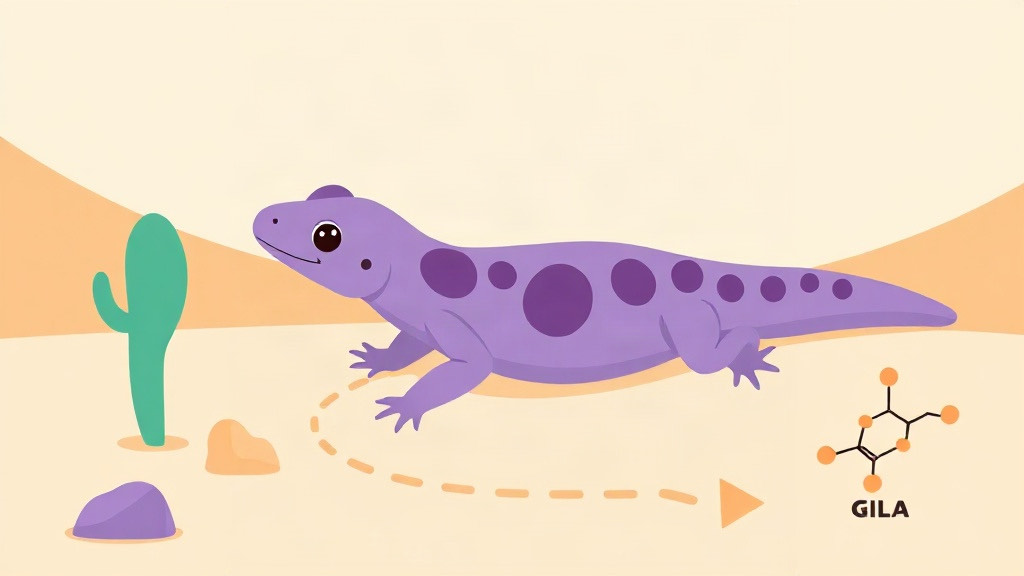
Every class of medication has an origin story. Most involve gleaming labs, screening libraries, and molecules with serial numbers. The GLP-1 class has those too, eventually. But it starts somewhere better: with a large, slow, venomous lizard dozing under a rock in the American Southwest.
If you take Ozempic, Wegovy, Mounjaro, Zepbound, or any of their relatives, part of your prescription's family tree runs directly through that lizard. This is the story, and it is also the answer to a question we get a lot: why is the mascot of a medication tracker app a purple gila monster?
Meet the gila monster
The gila monster (Heloderma suspectum) is a stocky, beaded-skinned lizard native to the deserts of the American Southwest, and one of the few lizards on Earth that is venomous. It spends most of its life out of sight, moves with absolutely no sense of urgency, and would clearly have been voted "least likely to revolutionize metabolic medicine" by the rest of the desert.
And yet. Hidden in its venom was a molecule that would end up reshaping how tens of millions of people manage diabetes and weight. The lizard, to be clear, remains unimpressed.
A quick reassurance for the squeamish: no gila monsters are involved in making today's medications. The molecule the venom revealed has long since been made synthetically in laboratories. The lizard contributed an idea, not an ingredient, and it is the idea that changed everything.
A venom researcher in the Bronx
The human half of the story is Dr. John Eng, a physician-researcher working at the Veterans Affairs Medical Center in the Bronx in the early 1990s. Eng studied venoms, on the logic that molecules evolved to powerfully affect a victim's body chemistry might, in the right hands, be turned into medicine.
In gila monster venom, he identified a previously unknown peptide, a small protein, which he named exendin-4. It was not a random find; it was the payoff of patient, unglamorous measurement of what these venoms actually contained. What made exendin-4 remarkable was not just what it did, but how long it kept doing it.
It is worth pausing on how unfashionable this work was. Venom chemistry at a veterans' hospital was nobody's idea of a hot field, and there was no guarantee that patiently cataloguing peptides would lead anywhere at all. The discovery that followed is a standing argument for curiosity-driven science.
The problem exendin-4 solved
Here is the background the discovery needed. Your own gut makes a hormone called GLP-1, released when you eat, which helps regulate insulin and appetite. As a potential medicine it had one crippling flaw: an enzyme called DPP-4 dismantles it within minutes of its release. A signal that vanishes that fast is nearly useless as a drug; you cannot inject something every few minutes.
Exendin-4 threaded the needle. It activates the very same human GLP-1 receptor, so it delivers the same kind of signal, but its structure resists DPP-4's demolition work. Instead of minutes, it lasts hours. That single difference, a GLP-1 signal that sticks around, is the foundation the entire modern class is built on. A lizard peptide proved the concept that chemists would spend the next two decades perfecting.
From venom to pharmacy shelf: 2005
The synthetic form of exendin-4 was named exenatide, and in 2005 the FDA approved it, under the brand name Byetta, as the first GLP-1 receptor agonist. By today's standards it was demanding: a twice-daily injection (5 and then 10 micrograms, per its label), with a half-life of roughly 2.4 hours. By the standards of the time it was a landmark, an entirely new way to treat type 2 diabetes, sourced from one of the least likely places in pharmacology.
The approval was also a vindication of the whole unlikely path: a peptide first spotted in venom, remade synthetically, now sitting in pharmacies as a prescription medicine. Drug discovery rarely offers a cleaner before-and-after. And once exenatide showed that a durable GLP-1 signal worked, the race was on to make it last longer.
The family tree it started
Everything since has been, in a sense, an engineering project on that lizard's insight. Liraglutide (Victoza, Saxenda) stretched the half-life to about 13 hours: one shot a day. Dulaglutide (Trulicity) and then semaglutide (Ozempic, Wegovy) pushed it to roughly five days and one week respectively: one shot per week. Tirzepatide (Mounjaro, Zepbound) added a second hormone signal, GIP, alongside GLP-1, on the same weekly cadence. Semaglutide even learned to survive as a daily tablet, Rybelsus. GLP-1 is not the only hormone in the fullness story, either; our explainer on amylin analogues, the other fullness hormone, picks up that thread.
Those long half-lives are not trivia; they shape daily life on these medications, from the month-long climb to steady state to the forgiving missed-dose windows. We wrote plain-English explainers on both the semaglutide half-life and the tirzepatide half-life, and the slow dose ladders every one of these medications climbs are laid out in our titration schedules guide. Every weekly pen in every refrigerator owes its convenient schedule to the proof of concept found in venom. The schedules grew gentler in another way too: every one of these medications now climbs a gradual ladder of doses over months, a far cry from the fixed twice-daily rhythm Byetta began with.
 GLP 1 Tracker AppFree on the App Store. Dose logging, an educational level curve, and Gigi the gila monster cheering you on.
Get the app
GLP 1 Tracker AppFree on the App Store. Dose logging, an educational level curve, and Gigi the gila monster cheering you on.
Get the app
Why our mascot is a gila monster named Gigi
When we built GLP 1 Tracker App, we wanted a companion in the app: something friendly to keep you company through what is, honestly, a repetitive routine of logging shots, water, protein, and weight. The choice of animal was never really a debate. If any creature has earned a place in a GLP-1 app, it is the one whose venom started the whole field.
So the app's companion is Gigi, our gila monster. Real gila monsters wear black and orange; Gigi wears purple, an artistic liberty we suspect the species will forgive. She is there on the free tier for everyone, quietly keeping you company as the log fills up. She dispenses no medical advice, which makes her better qualified than much of the internet.
She also solves a small design problem honestly. Medication tracking is repetitive by nature, and most apps try to fix that with streaks, badges, and guilt. A companion who is simply glad to see you is friendlier arithmetic.
There is also something fitting about the temperament. The gila monster is unhurried, consistent, and built for the long haul, which is a fair description of GLP-1 treatment itself: slow ladders, weekly rhythms, progress measured in months. A sprinting mascot would have been dishonest. A patient desert lizard is exactly right, and if you want to see what she is a mascot for, our overview of what makes a good GLP-1 tracker is the tour.
The takeaway
In the early 1990s, John Eng looked in gila monster venom and found exendin-4, a molecule that speaks to the human GLP-1 receptor but resists the enzyme that silences our own hormone in minutes. In 2005 its synthetic form, exenatide, became the first FDA-approved GLP-1 receptor agonist, and the class it opened now includes liraglutide, semaglutide, and tirzepatide. The next time you press a pen to your skin once a week and go about your life, spare a thought for a venomous lizard under a desert rock. Gigi would appreciate it.
Frequently asked questions
Do GLP-1 drugs like Ozempic really come from gila monster venom?
The class traces back to it. In the early 1990s, Dr. John Eng identified a peptide called exendin-4 in gila monster venom at the Bronx VA. It activates the human GLP-1 receptor but resists the DPP-4 enzyme that dismantles our own hormone within minutes. Its synthetic form, exenatide, became the first FDA-approved GLP-1 medication in 2005 and opened the class that led to semaglutide and tirzepatide.
Is there actual lizard venom in Ozempic or Mounjaro?
No. No gila monsters are involved in making today's medications. The venom contributed an idea: a molecule that delivers a lasting GLP-1 signal. Exenatide, the synthetic copy of the venom peptide, has long been made in laboratories, and later medications such as liraglutide, semaglutide, and tirzepatide are different molecules engineered on the same principle.
What was the first GLP-1 drug approved by the FDA?
Exenatide, sold as Byetta, approved by the FDA in 2005 as the first GLP-1 receptor agonist. It is the synthetic form of exendin-4, the peptide found in gila monster venom, and it was taken as a twice-daily injection with a half-life of roughly 2.4 hours. The class it opened went on to produce daily liraglutide and the weekly medications semaglutide and tirzepatide.
Why is the GLP 1 Tracker App mascot a gila monster?
Because the whole medication class began with one. The app's companion, Gigi, is a tribute to the lizard whose venom contained exendin-4, the molecule that proved a lasting GLP-1 signal could work. Real gila monsters wear black and orange; Gigi wears purple. She is part of the free tier, keeps you company as the log fills up, and dispenses no medical advice.