The initials are everywhere now, printed on pens and pharmacy bags and running through every conversation about weight and diabetes. Most people using a GLP-1 medication could not say what the letters stand for, which is fine, but the answer is more interesting than it sounds and it explains a surprising amount about how these medications feel day to day.
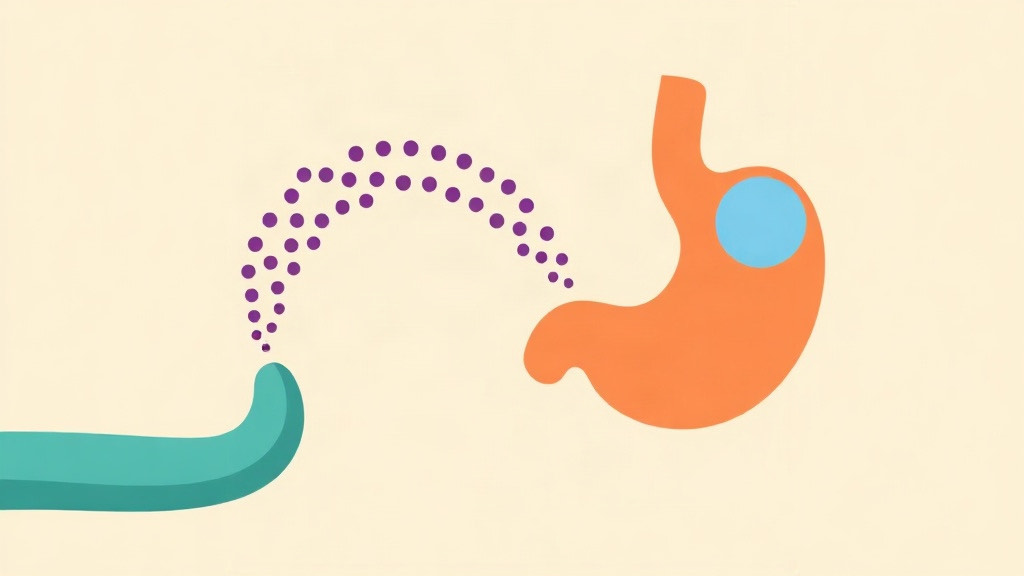
Here is the short version. GLP-1 is not a drug. It is a hormone your own intestine has been making your entire life, released every time you eat, and it does a handful of specific jobs that add up to a coherent message: food has arrived, respond accordingly.
The name, and what it is not
GLP-1 stands for glucagon-like peptide-1. It is a peptide, meaning a short chain of amino acids, and it earned the first part of the name because its structure resembles glucagon, a different hormone made in the pancreas.
That resemblance is a chemistry observation and not a job description, which trips people up. Glucagon and GLP-1 are structurally related and functionally distinct; in several respects they pull in opposite directions, a point that becomes important once you look at the newer multi-receptor medications that engage both.
The part worth holding onto is that nothing about GLP-1 was invented by a pharmaceutical company. It was discovered sitting in human biology where it had always been. What companies eventually invented was a way to make it last.
Where it comes from, and when
GLP-1 is secreted by L-cells lining your intestine, and they release it in response to eating. It belongs to a small family of hormones called incretins, gut signals that go out when food arrives and prime the rest of the body to deal with it.
That timing is the whole design. GLP-1 is not a background hum running at a constant level. It rises after a meal, does its work, and is gone. The body is using it as a message about a specific event, which is why the natural version is built to be short-lived, and why turning it into a medication was harder than it looks.
The four jobs
Strip away the physiology and GLP-1 does four things. Every one of them will be familiar to anyone who has taken one of these medications, because the medications engage the same receptor and produce recognizable versions of the same effects.
- It helps the pancreas release insulin, but only when blood sugar is up. This is the conditional part, and it matters enormously. The signal scales with glucose rather than firing regardless of it.
- It tells the pancreas to ease off glucagon. Glucagon raises blood sugar by prompting the liver to release stored glucose. After a meal, that is not what the body needs, so GLP-1 dials it down.
- It slows how fast the stomach empties. Food moves into the intestine more gradually, which spreads out the arrival of glucose and keeps the stomach fuller for longer.
- It contributes to the feeling of having had enough. Satiety, in the clinical word. This is the effect people notice most and describe least precisely.
Notice that these are not four unrelated tricks. They are four expressions of one instruction, issued at the moment food shows up: handle this glucose carefully, do not add more, take your time, and you can stop now.
 GLP 1 Tracker AppFree on the App Store. An educational medication level curve, dose ladders and a side effect diary, all on your phone.
Get the app
GLP 1 Tracker AppFree on the App Store. An educational medication level curve, dose ladders and a side effect diary, all on your phone.
Get the app
The catch: less than two minutes
Here is the fact that makes the entire drug class make sense, and it is the one most articles skip.
The half-life of bioactive GLP-1 in circulation is less than two minutes. Not hours. Not even one hour. An enzyme called dipeptidyl peptidase-4, universally shortened to DPP-4, finds circulating GLP-1 and inactivates it almost as fast as the gut can release it.
For a meal signal, that is elegant engineering: the message is loud, brief, and cannot linger past its usefulness. For anyone hoping to bottle it, it is a disaster. You cannot build a treatment around a molecule that is gone before the syringe is back in the drawer.
So the problem was never how to find GLP-1, or even how to synthesize it. It was how to make a version that DPP-4 cannot take apart. That is precisely what the modern medications are: degradation-resistant GLP-1 receptor agonists, molecules that engage the same receptor as the natural hormone while surviving the enzyme that ends it.
The payoff is visible in the numbers on any prescribing label. Semaglutide lasts about a week, tirzepatide and dulaglutide about five days, and liraglutide, an earlier and shorter-acting design, about 13 hours. The natural hormone lasts under two minutes; the engineered versions last days, which is why a weekly injection builds toward a steady level over roughly a month rather than spiking and vanishing. Our guide to the semaglutide half-life follows that curve in detail.
| The GLP-1 your gut makes | A GLP-1 receptor agonist medication | |
|---|---|---|
| Source | L-cells in the intestine, released when you eat | Injected or swallowed on a set schedule |
| Half-life | Less than two minutes | Hours to days, depending on the molecule |
| What ends it | Rapid inactivation by the DPP-4 enzyme | Engineered to resist DPP-4 |
| Pattern | A brief pulse with every meal | A level that builds and holds between doses |
If you want the story of how anyone worked out that a longer-lasting version was possible, it did not come from a laboratory bench. It came from a lizard, and we tell that story in the gila monster behind GLP-1 drugs.
Why glucose-dependent is the phrase that matters
Of the four jobs, the first one carries a qualifier that deserves its own section: GLP-1 stimulates insulin secretion in a glucose-dependent manner.
In plain terms, the insulin-prompting effect scales with how much glucose is around. When blood sugar is up after a meal, the signal is strong. When blood sugar is low, the signal quiets down. The hormone is not pushing insulin out on a fixed schedule; it is responding to conditions.
This is the single most practically important thing about the class, because it is the reason GLP-1 medications on their own do not drive blood sugar down the way some other medications can. The mechanism has a built-in floor.
The important caveat is that the picture changes when a GLP-1 is combined with insulin or a sulfonylurea, which work differently and do not have that same conditionality. That combination is a real consideration and a prescriber conversation, and we cover what to watch for in GLP-1s and blood sugar.
What this means when you are tracking
Understanding the hormone changes what your own log looks like, because most of what you are recording is one of those four jobs showing up in daily life.
Slowed gastric emptying explains a great deal. The early fullness three bites into a plate you used to finish. The meal that still feels present two hours later. The reflux that turns up in the evening. The nausea that clusters after a dose increase and settles over the following weeks. These are not random side effects arriving from nowhere; they are the most noticeable consequence of a stomach that is emptying more slowly, which is why our guide to nausea patterns spends so much time on timing rather than on remedies.
The satiety effect is real and hard to measure. The quieting of intrusive thoughts about food that many people describe, and call food noise, is a patient-reported experience rather than something we can point at a mechanism and explain. It is widely described and worth writing down, both because it tends to arrive earlier than weight change and because it can fade in ways that are useful to notice. Our article on food noise treats it on those terms.
And the timeline makes sense once you know the half-life. If the natural hormone lasted two minutes and the engineered version lasts a week, then nothing about your experience should be expected to change within an hour of an injection, and everything should be expected to shift gradually over the first month. That is the rhythm to track: not what happened today, but what the last four weeks look like laid out side by side.
A hormone your gut has been quietly releasing after every meal of your life, rebuilt to last days instead of minutes. That is the whole idea. Everything else is engineering.
Try it freeLog doses, appetite notes and side effects, and watch the first month take shape. No account, nothing leaves your phone.
Download
Frequently asked questions
What does GLP-1 actually stand for?
Glucagon-like peptide-1. It is a hormone, not a brand, and it got the name because its molecular structure resembles glucagon, a different pancreatic hormone. The similarity in the name is a chemistry observation rather than a description of what it does, which occasionally causes confusion, because in several respects GLP-1 and glucagon pull in opposite directions.
Does your body make GLP-1 on its own?
Yes. GLP-1 is an incretin hormone secreted by L-cells in your intestine in response to eating, and it has been doing that job your whole life. The medications are not introducing a foreign substance so much as sustaining a signal your gut already sends. What they change is how long that signal lasts, from a couple of minutes to a matter of days.
Why is natural GLP-1 not used as a medication?
Because it disappears almost immediately. The half-life of bioactive GLP-1 in circulation is less than two minutes, since an enzyme called dipeptidyl peptidase-4, or DPP-4, inactivates it very rapidly. A hormone that short-lived cannot be given as a practical treatment. That problem is exactly what led researchers to develop degradation-resistant GLP-1 receptor agonists, the class the modern medications belong to.
Why do GLP-1 medications slow down digestion?
Because slowing gastric emptying is one of the natural hormone's own jobs, and the medications engage the same receptor. Food leaves the stomach more gradually, which is part of why people feel full sooner and stay full longer. It is also the reason nausea, reflux and early fullness are the most commonly reported effects, particularly after a dose increase, per the prescribing information.
What does glucose-dependent mean for a GLP-1 medication?
It means the insulin-stimulating effect scales with your blood sugar rather than running regardless of it. When glucose is up, the signal is strong; when glucose is low, it quiets down. That is why this class does not push blood sugar down the way some other medications can. The picture changes when a GLP-1 is combined with insulin or a sulfonylurea, which is a conversation for your prescriber.