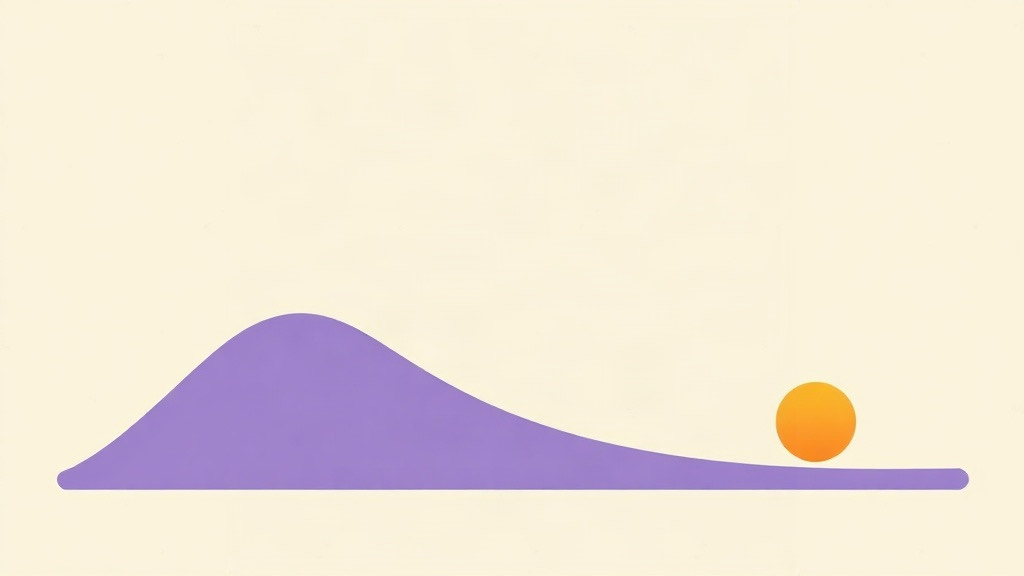
Somewhere between the third month and the second year of any weight-loss effort, the curve flattens. It happens on GLP-1s, it happened on every approach that came before them, and it will happen on whatever comes next. The stall is close enough to universal that the interesting question is not whether it arrives but what it is actually made of.
The practical playbook for a stalled scale, what your own data can show you and what belongs in a conversation with your prescriber, has its own guide in Hit a Plateau on a GLP-1? What Your Data Can Tell You. This article stays underneath the playbook, on the mechanism, because the mechanism is widely misrepresented. Two separate things happen as weight falls. Only one of them is controversial. Neither deserves the phrase most often attached to them.
Two things happen, and only one is debated
The first thing is mechanical and uncontroversial: a smaller body costs less to run, so the same eating pattern produces a smaller deficit over time. The second thing is adaptive and genuinely argued about: beyond what body composition predicts, energy expenditure in people maintaining a reduced weight tends to run lower still. Researchers have measured both, and they still disagree about the size of the second.
Keeping the two separate is the whole discipline of this subject. Popular accounts blur them into one ominous force, and the blur is where the phrase metabolic damage comes from. Take them one at a time and the picture is far less dramatic, and far more useful.
The mechanical part: the gap simply closes
A body that weighs less has less tissue to maintain and less mass to move through the world. Resting expenditure falls, and so does the energy cost of walking the same distance you walked at the starting weight. None of this is a malfunction. It is the arithmetic of being smaller.
Follow the arithmetic to its end and the plateau appears on schedule. The eating pattern that produced a deficit at the starting weight produces a smaller deficit at the new weight, and eventually, if nothing changes, no deficit at all. Weight loss slows because the engine driving it shrinks. Nothing has gone wrong; the gap closed.
This part alone would flatten every weight-loss curve in existence. It requires no controversial biology, no invoked ancient survival mechanisms, and it explains most of what people attribute to something more mysterious.
The adaptive part: real, smaller and genuinely contested
Beyond the mechanical drop, there is a measured effect that body composition does not explain. The landmark work came from Leibel, Rosenbaum and Hirsch in the New England Journal of Medicine in 1995, with a body of research following it: people maintaining a weight reduction of 10 percent or more showed energy expenditure roughly 300 to 400 kcal per day below what their new body composition predicted, with much of it attributed to increased efficiency of skeletal muscle work.
The study that dominates the conversation is more extreme. Fothergill and colleagues, publishing in Obesity in 2016, followed 14 of the 16 contestants from a 30 week televised weight loss competition for six years. Average loss at the end of the competition was 58.3 kg, and resting metabolic rate had fallen 610 kcal per day. Six years later, 41.0 kg had been regained on average, resting metabolic rate was still 704 kcal per day below baseline, and metabolic adaptation, defined as the residual after adjusting for body composition and age, was 499 kcal per day. Those numbers anchor the darkest versions of this story, and they come from one of the most extreme weight-loss interventions ever documented.
Then the interpretation moved. Kevin Hall revisited the same data in Obesity in 2022 through a constrained energy expenditure model, and the picture changed. The contestants had sustained very large increases in physical activity, and the drop in resting metabolic rate looked like a compensatory trade against that activity rather than damage from the weight loss itself. The adaptation was largest in the contestants whose activity increased most, and, crucially, those who sustained the most activity maintained their weight loss best. Weight loss programs with ordinary activity levels have not shown adaptations anywhere near that size.
The argument is live at the highest level of the field. The American Journal of Clinical Nutrition ran a point and counterpoint on exactly this question in 2022, under titles including Metabolic adaptation is not a major barrier to weight-loss maintenance. Published nutrition scientists disagree, in print, about how large and how durable the effect is. This article will not resolve a debate the researchers themselves are still having. It is enough to say the effect is real, smaller than the folk version, and contested in magnitude.
 GLP 1 Tracker AppWeight trend, protein, water and doses in one private place, so a flattening curve becomes data instead of dread.
Get the app
GLP 1 Tracker AppWeight trend, protein, water and doses in one private place, so a flattening curve becomes data instead of dread.
Get the app
What this is not
It is not damage. Nothing in the literature describes a metabolism that has been broken and cannot be fixed. It is not evidence that losing weight was a mistake, and the contested part of the effect is a fraction of the size the loudest accounts imply. And an average measured across a group, whether the 300 to 400 kcal figure or the contestant data, says nothing about any reader's own number, which routine care does not measure.
The phrase starvation mode deserves its own sentence, because it is the folk term most people arrive with. It overstates a real but much smaller effect, dressing the modest dip in expenditure as a shutdown in which the body clings to every pound. Name it, recognize it, and retire it.
Why GLP-1 curves flatten too
In the major semaglutide and tirzepatide trials, average weight loss flattened out somewhere around 60 to 68 weeks. The medication did not stop working at that point in any sense the data supports. The flattening is simply what a closing deficit looks like on a chart: the same arithmetic, playing out under a medicine that made the earlier stretch more productive.
It is not the medication wearing off, and it is not a reason to start thinking about the dose, which is never the reader's decision or ours. The weeks around a stall are also when protecting lean mass earns its keep, since muscle is part of what the body costs to run; the practical side of that lives in Protein Goals on GLP-1s: Protecting Muscle While Losing Weight and Two Days of Strength Training: The GLP-1 Muscle Insurance, and none of it is a program to start without the prescriber's knowledge.
What a flattening curve is good for
A stall read as failure feels like an ending. A stall read as expected physiology becomes information: where the deficit closed, when it closed, and what the trend line has actually been doing underneath the weekly noise, a skill with its own guide in How to Read a Weight Trend Line.
The honest closing note is the one the research supports. The studies disagree about how large the adaptive effect is and how long it lasts, while agreeing about the direction: expenditure falls after weight loss, some of it predictably and some of it beyond prediction. A plateau is expected under every version of that story. What to do about yours is a conversation with your prescriber, held over your own data, and the earlier guide covers exactly how to have it.
Frequently asked questions
What is metabolic adaptation?
It is the finding that people maintaining a reduced weight can burn somewhat less energy than their new, smaller body composition would predict, beyond the expected drop that comes from simply having less tissue to maintain. The classic research, from Leibel, Rosenbaum and Hirsch in the New England Journal of Medicine in 1995 and the work that followed, put the gap at roughly 300 to 400 kcal per day in people maintaining a loss of 10 percent or more. How large and how durable the effect is remains debated.
Does losing weight permanently damage your metabolism?
No, and damage is the wrong word for what the research describes. Energy expenditure at a lower weight is genuinely lower, partly because a smaller body costs less to run and partly by an adaptive component that is real but smaller than popular accounts suggest. Nothing in the literature describes a metabolism that has been broken and cannot recover. Scientists disagree about the size of the adaptive part, not about whether weight loss was a mistake.
What did the study of the television weight loss contestants find?
Fothergill and colleagues, publishing in Obesity in 2016, followed 14 of the 16 contestants from a 30 week televised competition for six years. The average loss at the end of the competition was 58.3 kg, with resting metabolic rate down 610 kcal per day. Six years later, 41.0 kg had been regained on average, resting metabolic rate was still 704 kcal per day below baseline, and the adaptation after adjusting for body composition and age was 499 kcal per day. It is the most extreme dataset in the field, not a typical one.
Why did my weight loss slow down on my GLP-1?
Because the gap between what the body needs and what the eating pattern provides narrows as the body shrinks, and in the major semaglutide and tirzepatide trials average weight loss flattened out somewhere around 60 to 68 weeks. That flattening is what a closing deficit looks like on a chart. It is not the medication wearing off, and it is not a signal about doses, which belong entirely to the prescriber. The practical response to a stall is a separate subject with its own guide.
Is starvation mode real?
Starvation mode is a folk term that overstates a real but much smaller effect. Energy expenditure does fall after weight loss, both predictably, because there is less body to run, and adaptively, by an amount the research is still arguing about. Neither part matches the folk version, in which the body supposedly halts fat loss entirely and clings to every pound. The honest summary is a modest dip in expenditure, not a shutdown.