Mounjaro and Zepbound share one molecule, tirzepatide, and one schedule: an injection every seven days. Which raises a fair question about the other six. Is the medication still doing anything on day four? Day six? Is the last day before your next shot running on fumes?
The answer lives in one published number: tirzepatide's half-life of about five days. This article walks through what that number means for the shape of your week, why the first month is a slow climb, and why the official missed-dose window is exactly as long as it is.
A five-day half-life, in plain English
A half-life is the time your body needs to clear half of the medication currently in your system. Per the prescribing information, tirzepatide's is about five days, roughly 120 hours.
Run that forward. If you stopped injecting today, about half of the medication would still be circulating five days from now. Around day ten, a quarter. Around day fifteen, an eighth. Elimination is a slow, steady slope rather than an off switch, and at any given moment your body holds contributions from several past shots at once. If the concept itself is new to you, our semaglutide half-life guide builds it from the ground up; the logic is identical, only the clock speed differs.
The shape of a tirzepatide week
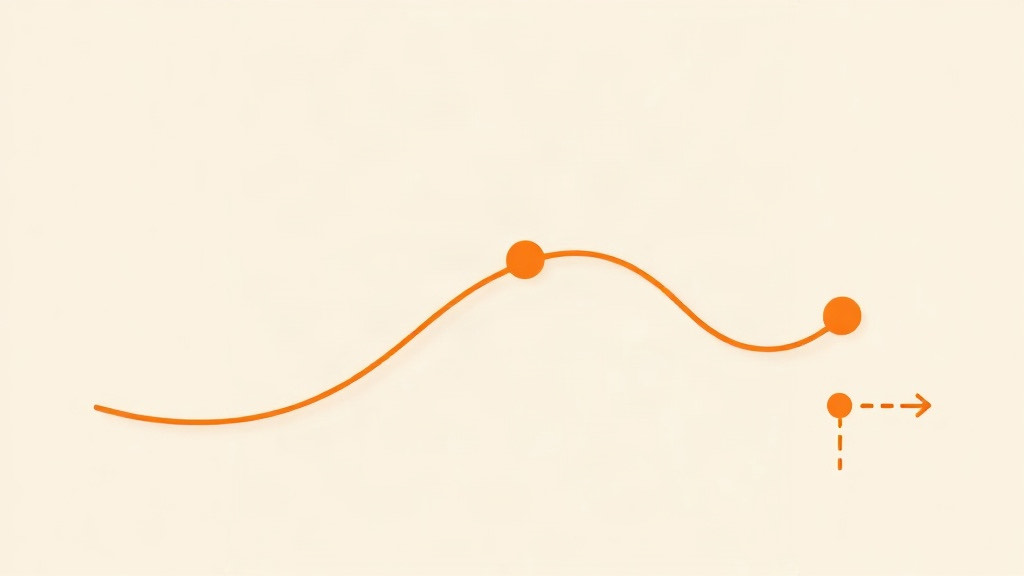
Each week follows the same arc. After the injection, the medication absorbs from under the skin and the level rises. It crests, then declines gradually through the rest of the week. Seven days is a bit more than one half-life, so by the next shot day the level has eased off noticeably, but it is nowhere near zero: a substantial share of last week's dose, plus smaller remnants of the weeks before it, is still on board when the new dose arrives.
That new dose tops the level back up, and the cycle repeats. Charted over a month, the level looks like a rising line with a gentle weekly ripple: up on shot day, easing between, never touching bottom. People sometimes ask whether the day before a shot should feel different. Experiences vary from person to person; the pharmacology only says the level is somewhat lower at the end of the week, not that the medication switches off.
There is a practical corollary hiding in that shape: because today's level always reflects the last several weeks of doses, consistency matters more than perfection. A shot that lands on the same day each week keeps the ripple even and the average steady, which is why a standing reminder, and a log that shows exactly when the last shot happened, do more for your levels than any amount of end-of-week worrying.
Why steady state takes about a month
Because each shot lands on leftovers, the total level climbs week over week at first. Every week the leftovers are a little larger, so the same dose produces a slightly higher total. But your body clears a fraction of whatever is present, so as the level rises, so does the amount cleared each week. Eventually input and clearance balance, and the level settles into a stable weekly rhythm called steady state.
The common rule of thumb is four to five half-lives to get there, which for tirzepatide works out to about a month. That timing rhymes with the design of the dose ladder: Mounjaro and Zepbound climb through six steps, from 2.5 up to 15 mg, with each step typically held for at least four weeks (and 2.5 mg serving as a starting step rather than a destination). By the time you and your prescriber evaluate a step, the level has had time to plateau. It also explains a common experience: week four at a given step can feel different from week one at that same step. The dose did not change; the accumulated level did. The full ladder, and the reasons it climbs so slowly, is covered in our guide to titration schedules. The steady-state idea itself gets a plain-English walkthrough of its own in why week five feels different.
Why the missed-dose window is four days
The Mounjaro and Zepbound labels say a missed dose can be taken within 4 days (96 hours); past that, skip it and resume your regular schedule. That window is not arbitrary, and the half-life math makes it intuitive.
Four days after a missed shot day, meaningful medication from your previous doses is still circulating; taking the dose then simply refills the reservoir a little late. The labels pair this with a spacing rule: when doses shift around, tirzepatide injections should stay at least 72 hours apart. Take the late dose within the window and you can still respect that gap before your next scheduled shot. Wait longer, and the label says to skip rather than squeeze two doses close together. And the rule every label shares: never take a double dose to make up for a missed one.
The practical catch is that the whole calculation depends on knowing exactly when your last shot was. "Sometime last week" cannot be inside or outside a 96-hour window; a timestamped log can. Our missed dose guide has the full set of windows for every GLP-1 medication.
 GLP 1 Tracker AppFree on the App Store. The Mounjaro and Zepbound dose ladders built in, every shot stamped to the minute.
Get the app
GLP 1 Tracker AppFree on the App Store. The Mounjaro and Zepbound dose ladders built in, every shot stamped to the minute.
Get the app
Watching it as a curve
GLP 1 Tracker App draws all of this as an educational medication level curve built from the doses you actually log, using published half-life values like the five days above. The line rises after each logged shot and eases off between them, so the first-month climb, the weekly ripple, and the dip left by a late dose all become visible in your own history rather than in a textbook diagram.
Two honest limits come with that picture. First, it is an educational estimate, not a measurement: no app can know your real blood concentration, because absorption and clearance differ from body to body, and only a laboratory test measures an actual level. Second, the curve never advises doses. It will not tell you whether to take a late shot or what step you should be on; those calls belong to the label and your prescriber. The curve's job is smaller and genuinely useful: it replaces "is anything even in my system?" with a calm, roughly right shape. That calm is worth something in the anxious first month, when it is easy to mistake a slow climb for nothing happening.
Tirzepatide next to semaglutide
Both weekly medications run the same accumulation logic at slightly different speeds. Semaglutide's half-life is about a week, tirzepatide's about five days, so tirzepatide's level ebbs a little more between shots and its missed-dose window is correspondingly tighter: 4 days versus Ozempic's 5. Both reach steady state in about a month. One practical difference worth knowing: tirzepatide works through two hormone receptors (GIP alongside GLP-1), which is a story for our Mounjaro tracking guide; the level math in this article applies either way. For what that second receptor actually does, our guide to GIP and glucagon is the deep dive.
The takeaway
Tirzepatide runs on a five-day clock inside a seven-day schedule. That is why the level dips but never empties between shots, why steady state arrives after about a month, and why the labels give you a four-day grace window backed by a 72-hour spacing rule. None of the math works without timestamps, so log each shot when it happens, and if you want the fuller weekly routine around the log, start with the Zepbound guide or the Mounjaro guide above.
Frequently asked questions
How long does tirzepatide stay in your system?
Tirzepatide's half-life is about five days, roughly 120 hours, per the prescribing information. If you stopped injecting, about half would remain five days later, a quarter around day ten, and an eighth around day fifteen, so meaningful amounts take a few weeks to clear. These are published averages; individual absorption and clearance vary, and only a laboratory test measures an actual level.
How long until Mounjaro or Zepbound reaches steady state?
About a month. A common rule of thumb is four to five half-lives to reach steady state, and tirzepatide's half-life is about five days. In the early weeks each shot lands on leftovers from previous doses, so the level climbs before settling into a stable weekly rhythm. That is why week four at a given dose step can feel different from week one, even though every injection was identical.
What should I do if I miss my Mounjaro or Zepbound shot?
Per the labels, a missed tirzepatide dose can be taken within 4 days, or 96 hours, of the scheduled day; past that, skip it and resume your regular schedule. Injections should stay at least 72 hours apart, and you should never take a double dose to make up for a missed one. If more than one dose has been missed or anything is unclear, call your prescriber.
Is tirzepatide still working the day before my next shot?
Yes. Seven days is a bit more than one half-life, so the level has eased noticeably by the next shot day but is nowhere near zero. A substantial share of last week's dose, plus smaller remnants from earlier weeks, is still on board when the new dose arrives. The pharmacology says the level runs somewhat lower late in the week, not that the medication switches off.
Can an app show my real tirzepatide level?
No app can know your actual blood concentration. GLP 1 Tracker App draws an educational level curve from the doses you log, using published half-life values, so the first-month climb and the weekly ripple become visible in your own history. It is an educational estimate, not a measurement, and it never advises doses; only a laboratory test measures a real level.