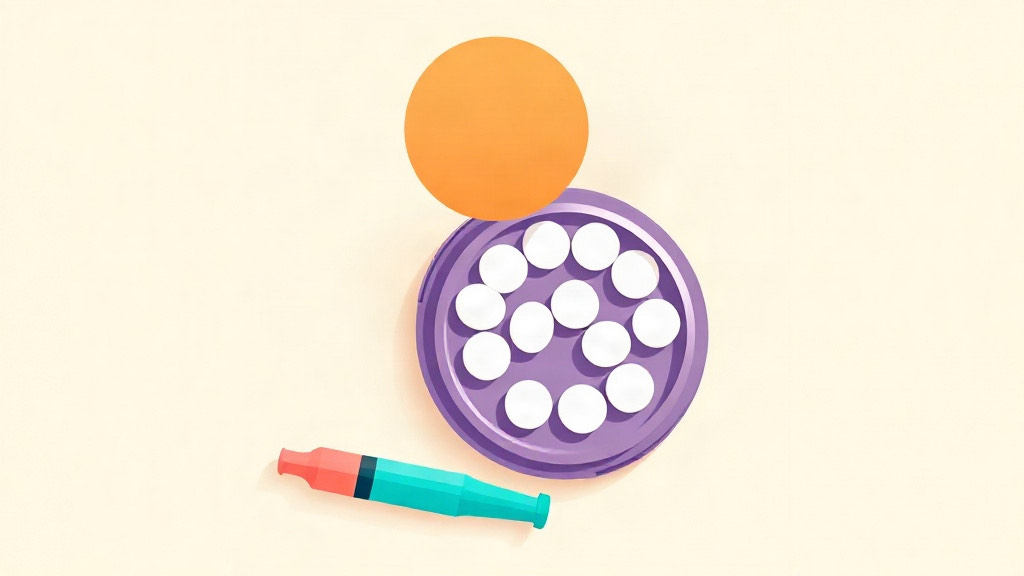
Most of what gets written about tirzepatide is about appetite, nausea and the weekly shot. One instruction in the Mounjaro and Zepbound labels gets far less attention, and it matters to anyone who takes a birth control pill: for a set period after starting, and again after every dose increase, the labels recommend extra contraceptive cover.
This is not a reason for alarm, and it is not a verdict on whether tirzepatide is right for you. It is a timing detail with a clear rule attached, and the rule is straightforward once you know it exists.
What the tirzepatide labels say
The Mounjaro and Zepbound labels carry the same guidance, which makes sense: both brands contain tirzepatide. The labels state that tirzepatide may reduce the efficacy of oral hormonal contraceptives.
The reason given is delayed gastric emptying. Tirzepatide slows how quickly the stomach empties, and a contraceptive pill is swallowed into that slower stomach like everything else. The labels also describe how that effect behaves: the delay in gastric emptying is largest after the first dose and diminishes over time.
That second detail explains the shape of the recommendation. Rather than a permanent change, the guidance is built around windows. For 4 weeks after starting tirzepatide, and for 4 weeks after each dose escalation, people using oral hormonal contraceptives are advised to do one of two things:
- Switch to a non-oral contraceptive method, or
- Add a barrier method of contraception.
Those are the two options exactly as the labels state them. We are not going to rank or compare them; which one suits you is a conversation for your prescriber.
Why the guidance is about pills specifically
The instruction concerns oral hormonal contraceptives: hormonal birth control taken by mouth. The link to gastric emptying is the reason. A pill has to pass through the stomach, and the stomach is exactly what tirzepatide slows down.
If you use an oral contraceptive and you are starting tirzepatide, or climbing its dose ladder, the windows described above are written about your situation. If your contraception is not a pill, the labels' instruction is not written about your method. That is narrower than a guarantee that nothing applies, and a pharmacist can confirm whether anything in your medication list needs attention.
One boundary is worth stating plainly: questions about pregnancy, or planning one, are outside the scope of this article and belong with your prescriber.
Every dose increase starts a new window
This is the part most likely to catch people out. The window after starting is easy to keep in mind, because starting a new medication is a memorable event. The windows after each dose escalation are easier to lose, because by then the weekly shot has become routine and a step up can feel like a small administrative change.
It is not small for the purposes of this guidance. Tirzepatide is climbed in steps, and per the label the Mounjaro and Zepbound ladder runs 2.5, 5, 7.5, 10, 12.5 and 15 mg. The first dose starts the first window. Every move up the ladder after that is a dose escalation, and each one starts its own 4-week window from the day of the new dose.
| Point on the ladder | Dose | Where the 4-week window starts |
|---|---|---|
| Starting dose | 2.5 mg | Your first dose |
| Step up | 5 mg | Your first 5 mg dose |
| Step up | 7.5 mg | Your first 7.5 mg dose |
| Step up | 10 mg | Your first 10 mg dose |
| Step up | 12.5 mg | Your first 12.5 mg dose |
| Step up | 15 mg | Your first 15 mg dose |
Someone who climbs the whole ladder moves up five times after the starting dose, which means five windows on top of the first. Not everyone climbs every step, and how far and how fast you go is your prescriber's decision rather than a timetable to anticipate. For the pill, the rule underneath the table is simpler than the table: whenever your dose goes up, the 4-week clock starts again.
If your plan changes in a way that does not fit neatly into starting or stepping up, such as restarting after a break or moving to tirzepatide from another GLP-1, ask your pharmacist or prescriber how the guidance applies rather than assuming either way. Our guide to switching GLP-1 medications covers why a switch so often means climbing a ladder again, and GLP-1 titration schedules explained covers why the ladders exist at all.
 GLP 1 Tracker AppEvery dose and every step up the ladder, dated on your phone, so the day each window began is never a guess. Free, private, no account.
Get the app
GLP 1 Tracker AppEvery dose and every step up the ladder, dated on your phone, so the day each window began is never a guess. Free, private, no account.
Get the app
Foundayo, and the labels for other GLP-1s
Foundayo (orforglipron), a daily oral GLP-1 pill, carries a similar instruction on its label. People using oral hormonal contraceptives are advised to switch to a non-oral method or add a barrier method for 30 days after starting Foundayo and for 30 days after each dose escalation.
There is one difference worth understanding. Foundayo's effect on the absorption of oral contraceptives has not been evaluated in a clinical trial, so the instruction on its label is precautionary. Precautionary guidance on a label is still the guidance, and its shape matches tirzepatide's: a window after starting and a new one after every step up. Our guide to Foundayo (orforglipron), the daily GLP-1 pill explains how that medication is climbed in steps too.
Labels for other GLP-1 medications differ. We are not going to tell you that any other product does or does not affect the pill, because that answer lives in the label for the specific medication you take.
The practical step is short: ask your pharmacist whether your GLP-1 carries similar guidance about oral contraceptives. They can look at everything you take together, and it is worth asking again whenever something changes, such as a new medication or a new brand.
Keeping the dates straight
The guidance is easy to state and surprisingly easy to lose track of, because it is anchored to dates rather than to anything you can feel. Nothing about week three of a new step feels different from week five. The only reliable way to know whether you are inside a window is to know exactly when that window began.
Every window starts on one of two kinds of day: the day you started, or the day of a dose escalation. A dose log that records every dose and every step up the ladder answers both, months later, without asking your memory to do it.
In GLP 1 Tracker App, each dose is logged against your medication's real titration ladder, so your history shows the date of your first dose and the date you moved to each new step. A free-text note attaches to dose entries if you want to mark a step up in your own words. Shot-day reminders and overdue alerts help keep the weekly dose itself on schedule. Free history covers the last 30 days, and Premium adds unlimited history.
To be clear about what the app does not do: it does not provide a contraception reminder, and it will not tell you when a window ends. If you want a reminder, find the start or step-up date in your dose history, count forward 4 weeks (or 30 days for Foundayo), and put that end date in your phone's own calendar.
Have that history open when you ask the questions below, since the date you moved to your current dose is exactly the kind of date memory is worst at.
Questions to bring to your prescriber and pharmacist
None of these need a long appointment, and several can be settled at the pharmacy counter. Mention that you use an oral contraceptive, then ask:
- How the guidance on your medication's label applies to your plan
- Which of the label's two options, switching to a non-oral method or adding a barrier method, makes sense for you
- When your current window ends, based on your start date and your most recent dose increase
- Whether anything else you take carries similar guidance
- Whether a new window applies if your plan changes, for example with a restart or a switch
The log holds the dates; the people who know your health decide what those dates mean.
The takeaway
The Mounjaro and Zepbound labels state that tirzepatide may reduce the efficacy of oral hormonal contraceptives, because it delays gastric emptying and that delay is largest after the first dose. For people who use the pill, the labels recommend switching to a non-oral method or adding a barrier method for 4 weeks after starting and for 4 weeks after every dose escalation, so each step up the ladder restarts the clock. Foundayo's label carries a similar, precautionary 30-day instruction. Other labels differ, so ask your pharmacist about yours. Keep a dated record of every step, put the window end dates somewhere you will see them, and leave the decisions to your prescriber and pharmacist.
Know when every step beganA free dose log built on real titration ladders. No account, and nothing leaves your phone.
Download
Frequently asked questions
Does Mounjaro or Zepbound make birth control pills less effective?
The Mounjaro and Zepbound labels state that tirzepatide may reduce the efficacy of oral hormonal contraceptives. The reason given is delayed gastric emptying, and the labels note that this delay is largest after the first dose and diminishes over time. That is why the guidance is built around set windows after starting and after each dose increase rather than a permanent change. Your prescriber and pharmacist can explain how it applies to you.
How long after starting Mounjaro or Zepbound should I use backup birth control?
Per the Mounjaro and Zepbound labels, people using oral hormonal contraceptives are advised to either switch to a non-oral contraceptive method or add a barrier method of contraception for 4 weeks after starting tirzepatide, and for 4 weeks after each dose escalation. Those are the two options as the labels state them. Which one fits you is a decision to make with your prescriber, not something to choose from an article.
Does every tirzepatide dose increase affect the pill again?
The labels attach a new window to each increase, not only to the first dose. People using oral hormonal contraceptives are advised to switch to a non-oral method or add a barrier method for 4 weeks after each dose escalation. The Mounjaro and Zepbound ladder runs 2.5, 5, 7.5, 10, 12.5 and 15 mg, so every step up starts a fresh 4-week window from the day of the new dose.
Do other GLP-1 medications like Foundayo carry the same birth control guidance?
Foundayo (orforglipron), the daily GLP-1 pill, carries a similar instruction: switch to a non-oral method or add a barrier method for 30 days after starting and for 30 days after each dose escalation. Its effect on oral contraceptive absorption has not been evaluated in a clinical trial, so that instruction is precautionary. Labels for other GLP-1 medications differ, so ask your pharmacist whether the one you take carries similar guidance.
How can I tell when my birth control window on tirzepatide ends?
Each window starts on a date you can look up: your first dose, or the day of a dose escalation. A dose log that records every dose and ladder step, such as GLP 1 Tracker App, shows exactly when each one happened. The app does not provide a contraception reminder, so if you want one, count forward from that date and put the end of the window in your phone's own calendar.