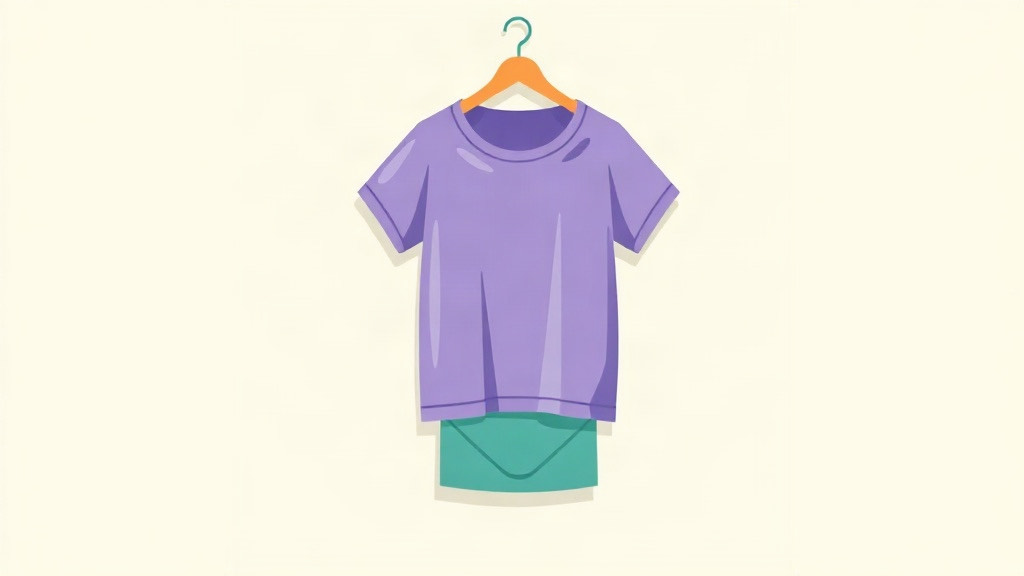
The scale gets the attention and the clothes do the daily work. Over a long stretch of weight change, clothes stop fitting not once but repeatedly, and each round arrives with a decision attached: spend now or make do, keep this or let it go, buy for the body of today or wait for whatever comes next. It is a mundane subject with real money and real feeling in it, and the page on Non-Scale Victories: The Progress Your Scale Misses notices it only in passing. The stages have a shape, the shape repeats, and knowing it in advance takes some of the sting out.
The stages, named plainly
The first stage is quiet: things get loose before they are too big. Waistbands gap, hems hang lower, sleeves slide down, and nothing has officially stopped working yet. The second stage is an event: a size change that announces itself, usually in a fitting room, usually with a jolt of something complicated. The third stage surprises people who expected the second to be the last: the next size down does not fit the way the last one did, because bodies do not shrink proportionally. Shoulders, waist, hips and chest change on their own schedules, and a body two sizes down is not the same body photographed two sizes down; it is a different shape that happens to wear a different number. The fourth stage, for people who reach a steady weight, is the one nobody warns you about: deciding when it is safe to buy properly again. What a target weight is and is not, if you are aiming at one, is its own subject at How to Set a Realistic Goal Weight on a GLP-1, and a long stall in the middle of the churn is covered at Hit a Plateau on a GLP-1? What Your Data Can Tell You, because the wardrobe question and the trend question are often the same question in different clothes.
Alter or replace
Between stages sits the practical decision: alter or replace. A belt is the cheapest tool in the entire process and carries the first stage almost alone. Beyond that, a tailor is cheaper than a wardrobe, and the arithmetic favors alteration most at the stages you expect to pass through: taking in the jacket you will wear for another two years beats replacing it twice. Some garments alter well and others do not, which is a tailor's question and worth asking directly, garment by garment, rather than deciding in the abstract. And the decision is not only financial. A stretch of months in clothes that fit badly has a cost of its own, in comfort and in how a day feels, and that cost is legitimate to weigh even when the spreadsheet says wait.
 GLP 1 Tracker AppProgress photos and a dated weight log, privately on your phone. A record of what changed and when, no account needed.
Get the app
What to keep and what to let go
The wardrobe question that carries the most feeling is what to do with the clothes on the way out, and both directions have a trap worth naming. Keeping everything turns a wardrobe into an archive of three bodies, with every hanger holding a running commentary, and the archive grows with each stage. Clearing everything out can feel, to some people, like betting against themselves, a declaration that there is no going back and never will be, which is a heavier thing to say with a trash bag than with a sentence. Neither trap is universal. Some people feel lighter with empty shelves; some people keep one box in the attic and stop thinking about it. The honest position is that this is a personal call with two failure modes, and the failure mode that would bother you is the one to design around.
The mirror problem
Underneath the wardrobe sits a stranger problem: many people report that their sense of their own size lags the change by months, so the person in their head is sized somewhere behind the person in the glass. Shopping goes wrong in both directions because of it: reaching for the old size out of habit, or the new one out of hope. This is where a dated visual record earns its keep, because memory smooths the change into a blur and a photograph does not. The app keeps progress photos as part of its free tracking, added from your photo library, and once there are two or more, a Then and now view sets the first beside the latest, which is the closest thing to an outside eye most people have in their pocket. How to use that record well is covered at Progress Photos That Actually Show Progress.
Skin, shape, and the end of the churn
Clothes sit differently on a changed body for reasons that are not only size, and shape is part of that story. The honest companion page is Loose Skin and Rapid Weight Loss, and it holds the same position this page does on the shopping that gathers around these subjects: it recommends no creams, supplements, devices or procedures, and neither do we. What the fitting room reports, that a garment cut for one body sits differently on another, is a tailoring observation and not a medical one, and it deserves neither alarm nor a purchase. Measurements are the gentler instrument when the number on the tag stops telling the story, and the ones worth recording are laid out at Beyond the Scale: Measurements Worth Tracking on a GLP-1.
Then, for people who stabilise, the churn ends. Weight settles somewhere, the stages stop arriving, and one day a purchase is just a purchase rather than a milestone or a gamble. The last round of buying is the one worth getting right, and life on the far side of a goal, including how tracking changes when the trend goes flat, is the subject of Maintenance Mode: Tracking After You Reach Goal Weight. Whether any individual reaches that stretch, and when, is not ours to predict; the wardrobe will tell them first anyway.
Frequently asked questions
What do I do when my clothes stop fitting on a GLP-1?
Expect it to happen more than once. Things get loose before they are too big, and a belt or a tailor is cheaper than replacing a wardrobe at every stage. Some garments alter well and others do not, so the decision is piece by piece. A stretch of months in clothes that fit badly has a cost of its own, and comfort is a legitimate reason to act.
Should I buy a whole new wardrobe during weight loss?
Probably not all at once, because the churn continues while weight is still moving. Interim choices carry the middle stretch: a few pieces that fit now, alterations on the garments that suit them, and patience with the rest. For people who reach a stable weight, the churn stops, and the last round of purchases is the one worth doing properly.
Should I keep my bigger clothes in case the weight comes back?
There is no single right answer, and both directions have a trap. Keeping everything can turn a wardrobe into an archive of three bodies. Clearing everything out can feel, to some people, like betting against themselves. Choose deliberately rather than by default, and let the choice be yours rather than a rule.
Why do I keep grabbing the wrong size when shopping?
Many people report that their sense of their own size lags the change by months, so shopping goes wrong in both directions: reaching for the old size out of habit or the new one out of hope. Progress photos help here, because a dated visual record is the closest thing to an outside eye on what actually changed and when.
Why do clothes fit strangely even at a smaller size?
Because bodies do not shrink proportionally, and because clothes sit differently on a changed body for reasons that are not only size. The next size down will not fit the way the last one did, at any stage. Measurements alongside weight help track the shape of the change, and skin and shape have their own subject.